Orca vs Great White Shark: Size, Strength & Who Actually Wins
Introduction
When it comes to orca vs great white size, most people are genuinely surprised by the answer. The great white shark is the world’s most famous ocean predator — immortalized by Jaws and decades of wildlife documentaries. But the orca, or killer whale, is in an entirely different league when it comes to raw size, intelligence, and hunting capability.
In this detailed guide, we’ll compare orca vs great white size across every metric — length, weight, teeth, speed, brain power, and real-world encounters — so you get the complete picture of how Earth’s two most iconic apex predators stack up against each other.
Orca vs Great White Size: The Basic Numbers
| Measurement | Orca 🐋 | Great White Shark 🦈 |
|---|---|---|
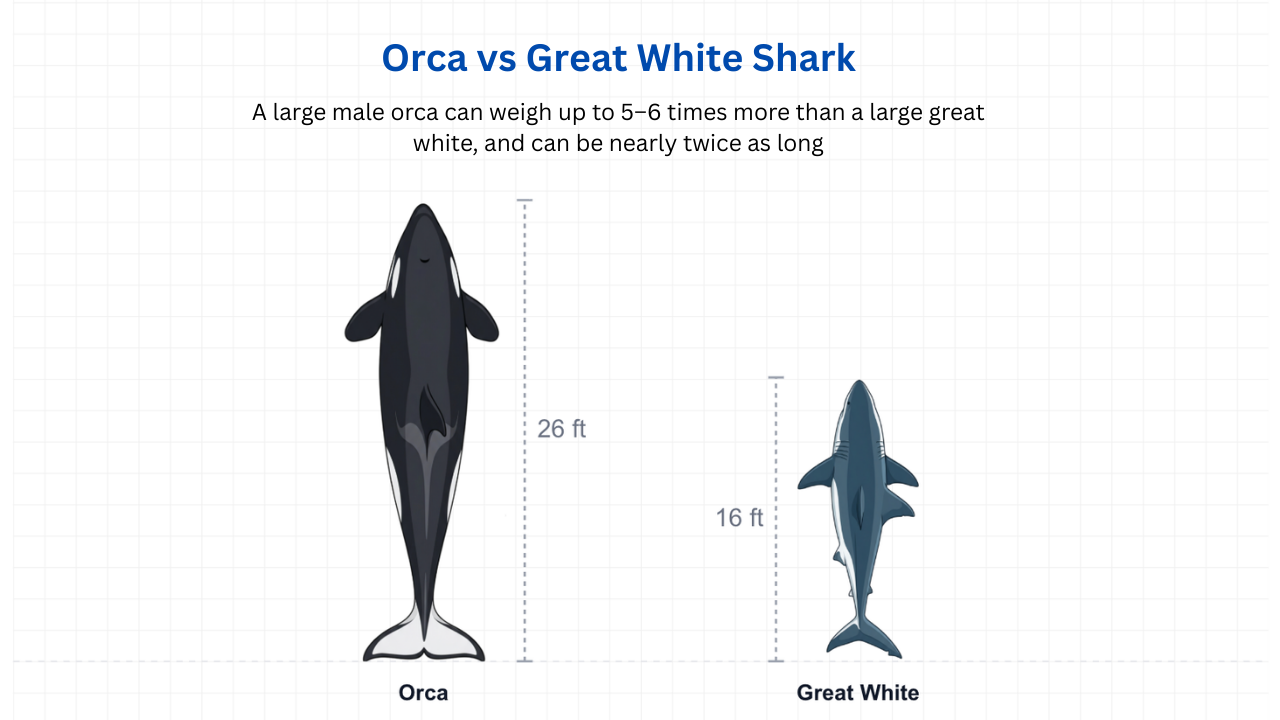
| Average Length (Male) | 6–8 meters (20–26 ft) | 4–5 meters (13–16 ft) |
| Average Length (Female) | 5–7 meters (16–23 ft) | 4.5–5.5 meters (15–18 ft) |
| Maximum Recorded Length | ~9.8 meters (32 ft) | ~6.1 meters (20 ft) |
| Average Weight (Male) | 4,000–6,000 kg (8,800–13,200 lbs) | 680–1,100 kg (1,500–2,400 lbs) |
| Maximum Recorded Weight | ~10,000 kg (22,000 lbs) | ~2,268 kg (5,000 lbs) |
| Body Type | Robust, torpedo-shaped mammal | Streamlined cartilaginous fish |
The numbers speak for themselves — orcas are dramatically larger than great white sharks. A large male orca can weigh up to 5–6 times more than a large great white, and can be nearly twice as long. This is perhaps the most shocking fact in the entire orca vs great white size debate for people who assumed the great white was the ocean’s biggest predator.
Physical Build: How They’re Shaped
The Orca
The orca (Orcinus orca) is the largest member of the dolphin family (Delphinidae) — not a whale in the true sense, despite the common name “killer whale.” Orcas are warm-blooded marine mammals, meaning they breathe air, nurse their young, and maintain a constant body temperature.
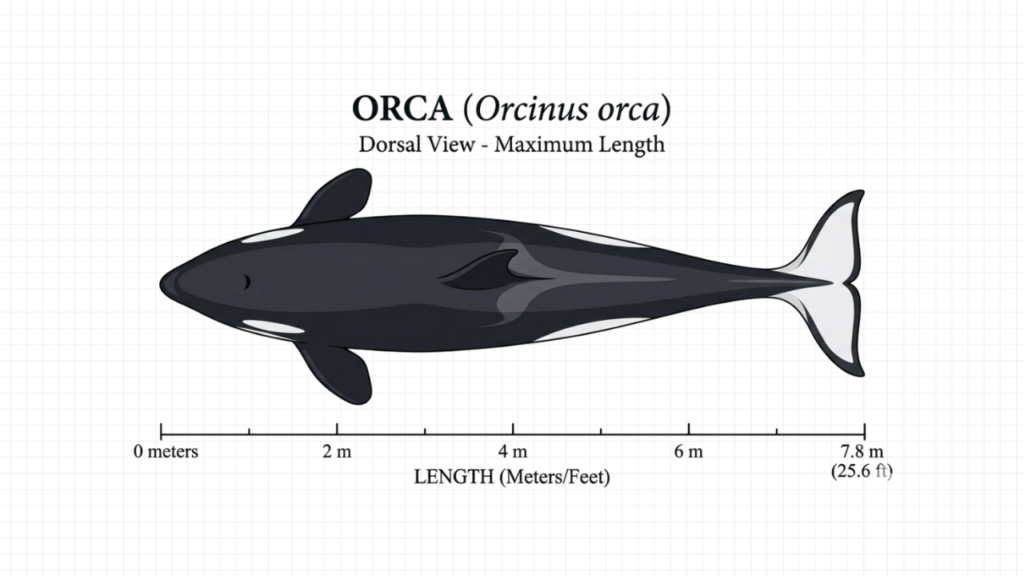
Key physical features:
- Distinctive black and white coloration — unique to each individual, much like a human fingerprint
- Dorsal fin can reach up to 1.8 meters (6 ft) tall in adult males — the tallest of any cetacean
- Powerful tail flukes move up-and-down (unlike fish, whose tails move side-to-side), generating tremendous thrust
- Conical interlocking teeth — up to 10 cm (4 inches) long, designed for gripping rather than cutting
- Large pectoral flippers used for steering and stability
- Thick blubber layer up to 10 cm deep — providing insulation and energy reserves
An adult male orca is essentially the size of a school bus — a living torpedo of muscle, fat, and intelligence cruising through the ocean at up to 56 km/h.
The Great White Shark
The great white shark (Carcharodon carcharias) is the largest predatory fish on Earth and a cartilaginous fish — meaning its skeleton is made entirely of cartilage, not bone. It is cold-blooded (technically counter-current heat exchange makes it slightly warm in core muscles), breathes through gills, and has been relatively unchanged for millions of years.
Key physical features:
- Counter-shaded coloring — dark grey/blue on top, white underneath — for camouflage when hunting from below
- Serrated triangular teeth arranged in multiple rows — up to 300 teeth at a time, replaced continuously throughout life
- Ampullae of Lorenzini — electroreceptor organs that can detect the electrical field of a heartbeat from meters away
- Lateral line system — detects pressure changes and vibrations in the water
- No swim bladder — must keep swimming or sink
- Rough denticle-covered skin — hydrodynamically efficient and tough as sandpaper
Despite being smaller than an orca, the great white is still an enormously powerful animal — capable of breaching completely out of the water when attacking prey from below.
Size at Birth: Even the Babies Are Big
| Stage | Orca 🐋 | Great White 🦈 |
|---|---|---|
| Birth Length | ~2.4 meters (8 ft) | ~1.2–1.5 meters (4–5 ft) |
| Birth Weight | ~180 kg (400 lbs) | ~25–30 kg (55–66 lbs) |
| Gestation Period | ~17–18 months | ~11 months |
| Litter Size | 1 calf | 2–10 pups |
A newborn orca calf is already larger than many adult sharks — arriving at around 8 feet long and 400 pounds. This gives a sense of just how massive the orca lineage truly is at every stage of life.
Teeth & Bite: A Tale of Two Predators
| Feature | Orca 🐋 | Great White 🦈 |
|---|---|---|
| Number of Teeth | 40–56 total | Up to 300 (multiple rows) |
| Tooth Shape | Conical, interlocking | Serrated triangles |
| Tooth Length | Up to 10 cm (4 inches) | Up to 6.5 cm (2.5 inches) |
| Bite Force | ~19,000 N estimated | ~18,000 N estimated |
| Tooth Replacement | No — permanent teeth | Continuous (hundreds over lifetime) |
| Primary Function | Grip and tear | Slice and saw |
Both animals have remarkably similar estimated bite forces — roughly 18,000–19,000 Newtons — making them among the most powerful biters in the ocean. However, their teeth serve very different purposes. The orca’s conical teeth are designed to grip, hold, and tear large prey, while the great white’s serrated triangular teeth are optimized for slicing through flesh and bone with a head-shaking cutting motion.
Crucially, orcas have permanent teeth — they only get one set for life, which must last 60–90 years. Great whites continuously replace their teeth throughout their lifetime, cycling through hundreds of teeth.
Speed & Agility Comparison
| Feature | Orca 🐋 | Great White 🦈 |
|---|---|---|
| Cruising Speed | ~8–10 km/h | ~3–5 km/h |
| Top Speed | ~56 km/h (35 mph) | ~40–48 km/h (25–30 mph) |
| Acceleration | Explosive, powerful | Fast burst, less sustained |
| Maneuverability | Highly agile for size | Moderate |
| Diving Depth | ~300–500 meters | ~1,200+ meters |
Orcas are faster than great whites despite being significantly larger and heavier — a testament to the power efficiency of their muscular body design and horizontal tail stroke. Orcas are also far more maneuverable, capable of making rapid direction changes that their shark prey cannot match.
Intelligence: The Biggest Difference of All
This is where the orca vs great white size comparison becomes even more one-sided.
Orca Intelligence
- Brain size: Among the largest brain-to-body ratios of any animal on Earth; second only to humans in absolute brain size among ocean mammals
- Self-awareness: Orcas pass the mirror test — one of the few animals capable of recognizing their own reflection
- Culture and dialects: Different orca pods have distinct vocalizations (dialects) passed down through generations — a hallmark of culture
- Tool use & teaching: Orcas teach their young specific hunting techniques — beaching behavior, wave-washing, carousel feeding — techniques that vary by pod and region
- Problem solving: Orcas have been documented devising complex cooperative strategies to hunt prey, including great white sharks
- Emotional bonds: Orcas maintain strong lifelong family bonds; females often live 60–90 years and lead their pods as matriarchs
Great White Intelligence
- Great whites are not unintelligent — they are curious, cautious, and capable of learned behavior
- They demonstrate investigative behavior, approaching unfamiliar objects methodically
- However, they are solitary hunters with no social structure, no cooperative hunting culture, and no evidence of self-awareness
- Their cognitive capability is fundamentally that of a highly refined instinct-driven predator, not a strategic thinker
In terms of pure cognitive power, the orca is in a completely different category — often described as the “wolves of the sea” for their pack intelligence, social structure, and cooperative hunting sophistication.
Orca vs Great White: Who Wins in Real Life?
This is not a hypothetical. There are documented, confirmed real-world encounters between orcas and great white sharks — and the results are always the same.
What Actually Happens
In multiple documented cases off the coasts of South Africa, California, and the Farallon Islands, orcas have been observed hunting and killing great white sharks. The behavior is methodical and calculated:
- Orcas work in coordinated pairs or pods — surrounding and disorienting the shark
- One orca grabs the shark’s pectoral fin, flipping it upside down — inducing tonic immobility (a natural paralyzed state in sharks)
- The orca then bites through the shark’s underside to extract the energy-rich liver — which in a great white can weigh up to 600 lbs and contains massive amounts of calorie-dense squalene oil
- The carcass is usually left behind after the liver is consumed
The Great White’s Response
Perhaps most tellingly, when orcas appear in an area, great white sharks flee immediately and entirely. Research from South Africa’s Gansbaai region — famous for its great white population — has shown that great whites will abandon feeding grounds for weeks or even months after a single orca appearance. Their electroreceptors appear to detect orca presence before they can even see them, triggering immediate evasion.
This is predator-prey behavior — the great white treats the orca not as a rival but as a threat to be avoided at all costs.
Lifespan & Reproduction
| Feature | Orca 🐋 | Great White 🦈 |
|---|---|---|
| Average Lifespan | 50–90 years | 40–70 years |
| Maximum Lifespan | ~100+ years (females) | ~73 years (estimated) |
| Sexual Maturity | 10–15 years | 9–10 years (female), 26 years (male) |
| Reproduction Rate | 1 calf every 3–10 years | 2–10 pups every 2–3 years |
| Parental Care | Intensive — years of maternal care | None after birth |
One of the most striking facts about great white sharks is that male great whites don’t reach sexual maturity until around age 26 — making them one of the slowest-maturing large marine animals and extremely vulnerable to population decline from overfishing and bycatch.
Conservation Status
| Status | Orca 🐋 | Great White 🦈 |
|---|---|---|
| IUCN Status | Data Deficient (some populations Endangered) | Vulnerable |
| Primary Threats | Pollution, prey depletion, noise, captivity | Finning, bycatch, media-driven fear, climate change |
| Global Population | ~50,000 estimated | ~3,500 estimated (severely uncertain) |
| Protected? | Yes, in most jurisdictions | Yes, in many countries |
The great white shark is in a far more precarious conservation position than the orca, with some estimates placing global numbers as low as 3,500 individuals — making them rarer than tigers. Their slow reproductive rate (males maturing at 26!) makes population recovery extremely slow.
Fun Size Facts: Orca vs Great White
- 🐋 The largest orca ever recorded was 9.8 meters (32 ft) long — nearly the length of two cars parked end to end
- 🦈 The largest reliably measured great white was 6.1 meters (20 ft) — the famous “Deep Blue” shark filmed off Mexico
- 🐋 An orca’s dorsal fin alone is taller than most adult humans
- 🦈 A great white’s liver can make up 24% of its total body weight
- 🐋 Orca calves are born at 8 feet long — already bigger than most adult humans
- 🦈 Great whites can go 3 months without eating after a large meal
- 🐋 Orcas can live to 100 years — with post-reproductive females (grandmothers) playing a critical role in pod survival
- 🦈 Great whites have been on Earth for approximately 11 million years; orcas for about 11 million years too — an accidental but perfect evolutionary parallel
Key Takeaways: Orca vs Great White Size
- Orcas are significantly larger — up to twice as long and 5–6 times heavier than great whites
- Orcas are faster, stronger, and far more intelligent
- In direct encounters, orcas consistently dominate great white sharks
- Great whites flee the area when orcas are present — classic prey behavior
- Despite the size difference, both are apex predators in their respective hunting contexts
- The great white is far rarer and more endangered than the orca
Conclusion
The orca vs great white size debate ends clearly — the orca wins on almost every physical and cognitive metric. Larger, heavier, faster, smarter, and more socially complex, the orca is arguably the most formidable predator in the ocean. The great white shark, for all its fearsome reputation and Hollywood fame, is outmatched in every documented real-world encounter with orcas.
Yet both animals are magnificent, irreplaceable parts of our ocean ecosystem — and both deserve far more protection than they currently receive. Understanding their true size, capability, and relationship is the first step toward appreciating just how extraordinary these creatures truly are.