Wolf vs Coyote Size: How Big Is the Difference?
Introduction
At first glance, wolves and coyotes can look surprisingly similar — same pointed ears, bushy tails, and sharp eyes. But when it comes to wolf vs coyote size, the difference is far more dramatic than most people expect. These two North American canids are closely related, yet they occupy very different positions in the wild — and size is the biggest reason why.
Wolf vs Coyote Size: The Numbers
| Feature | Gray Wolf | Coyote |
|---|---|---|
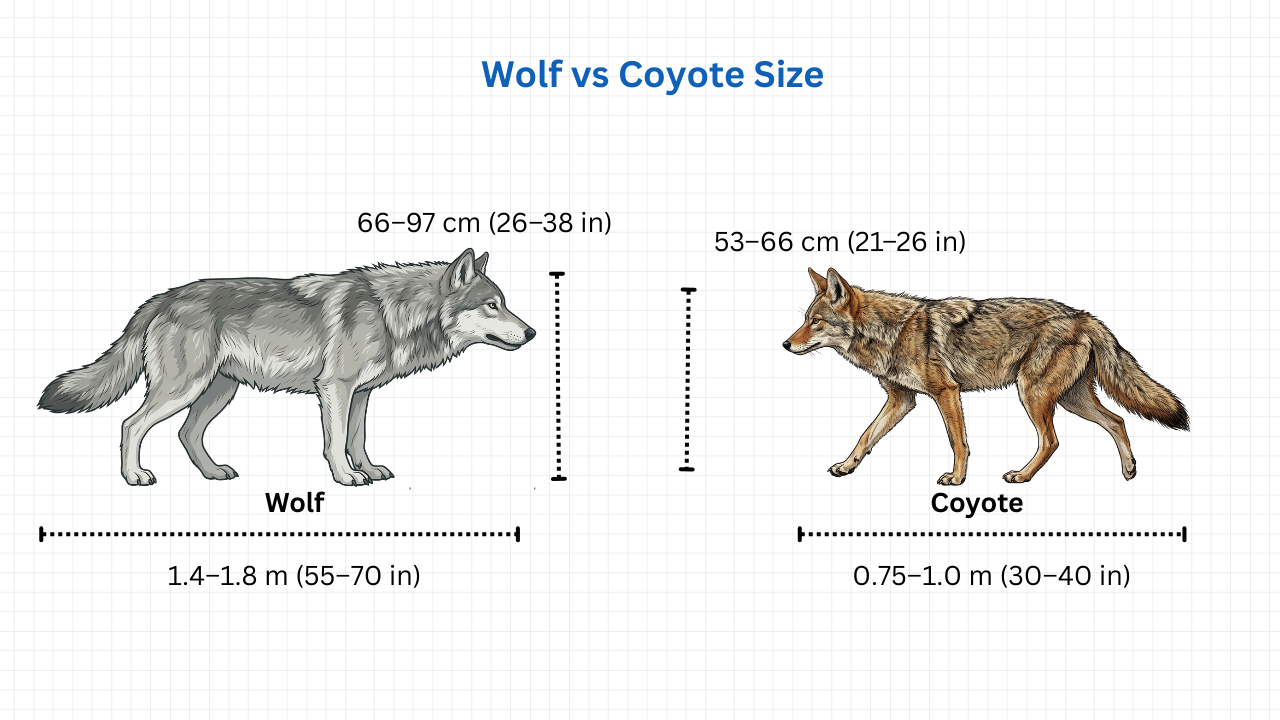
| Body Length | 1.4–1.8 m (55–70 in) | 0.75–1.0 m (30–40 in) |
| Shoulder Height | 66–97 cm (26–38 in) | 53–66 cm (21–26 in) |
| Weight (Male) | 30–80 kg (66–176 lbs) | 7–20 kg (15–44 lbs) |
| Tail Length | 33–51 cm | 30–40 cm |
| Paw Size | Much larger, broader | Smaller, narrower |
The numbers tell a clear story — wolves are roughly 3 to 4 times heavier than coyotes and significantly taller and longer in body. A large gray wolf from Canada or Alaska can tip the scales at 80 kg (176 lbs), while even the biggest coyote rarely exceeds 20 kg (44 lbs).
Body Build & Physical Differences
Beyond raw numbers, wolves and coyotes look different in several key ways once you know what to look for.
The wolf has a massive, blocky head with a broad, wide snout, thick powerful legs, and an overall impression of dense muscle and bulk. Its chest is deep and barrel-like, and its paws are enormous — designed for covering miles of terrain in snow and rough wilderness. Standing beside a coyote, a wolf looks like a completely different tier of animal.
The coyote is lean, nimble, and lightly built — almost fox-like in its slender proportions. Its snout is narrow and pointed, its legs are thin and quick, and its overall posture conveys agility rather than power. Where the wolf looks built for raw strength, the coyote looks built for speed and survival in almost any environment.
One easy field identification trick: a wolf carries its tail straight out or low while running, while a coyote typically runs with its tail pointed downward.
Habitat & Range
Wolves prefer large, undisturbed wilderness — forests, tundra, and mountain ranges across North America, Europe, and Asia. They need vast territories, sometimes spanning hundreds of square miles per pack.
Coyotes, by contrast, are one of North America’s great wildlife success stories of adaptability. Originally animals of open plains and deserts, coyotes have expanded dramatically into forests, suburbs, and even major cities. They thrive in almost every habitat on the continent — including places where wolves have long been absent. Their smaller size makes them far less dependent on large prey and large territory.
Hunting & Diet: Size Shapes Everything
A wolf’s size allows it to hunt large prey — elk, moose, bison, and deer — working in coordinated packs that can take down animals many times their individual size. Pack hunting is central to wolf survival and social structure.
A coyote’s smaller size means a very different menu — rabbits, rodents, birds, insects, fruit, and carrion make up the bulk of the diet. Coyotes are classic opportunists, eating whatever is available. They occasionally hunt in pairs or small family groups but rarely coordinate like wolves.
Key Takeaways
- Wolves are 3–4 times heavier than coyotes and significantly taller
- Wolves have broader heads, wider snouts, and much larger paws
- Coyotes are leaner, faster, and far more adaptable to human environments
- Size directly shapes diet — wolves hunt large prey, coyotes are opportunists
- Where wolves and coyotes share territory, wolves dominate and actively displace coyotes
Conclusion
The wolf vs coyote size comparison reveals two animals shaped by very different evolutionary pressures. The wolf evolved for raw power, pack coordination, and large prey in wild, remote landscapes. The coyote evolved for adaptability, speed, and survival in a rapidly changing world. Size isn’t just a number here — it defines everything about how these two remarkable animals live, hunt, and coexist in North America’s wild spaces.