Is a Moose Bigger Than a Horse? Size Facts That Will Shock You
Introduction
When people think of large hoofed animals, the horse usually comes to mind first. Majestic, powerful, and deeply familiar to humans for thousands of years, horses set the benchmark for big land animals in most people’s imagination. But when you put moose vs horse size side by side, the result genuinely surprises most people.
The moose — the largest member of the deer family — is a true giant of the animal kingdom. And in several key size metrics, it gives even the biggest horses a serious run for their money. Let’s break it all down.
Moose vs Horse Size: The Core Numbers
| Measurement | Moose | Horse |
|---|---|---|
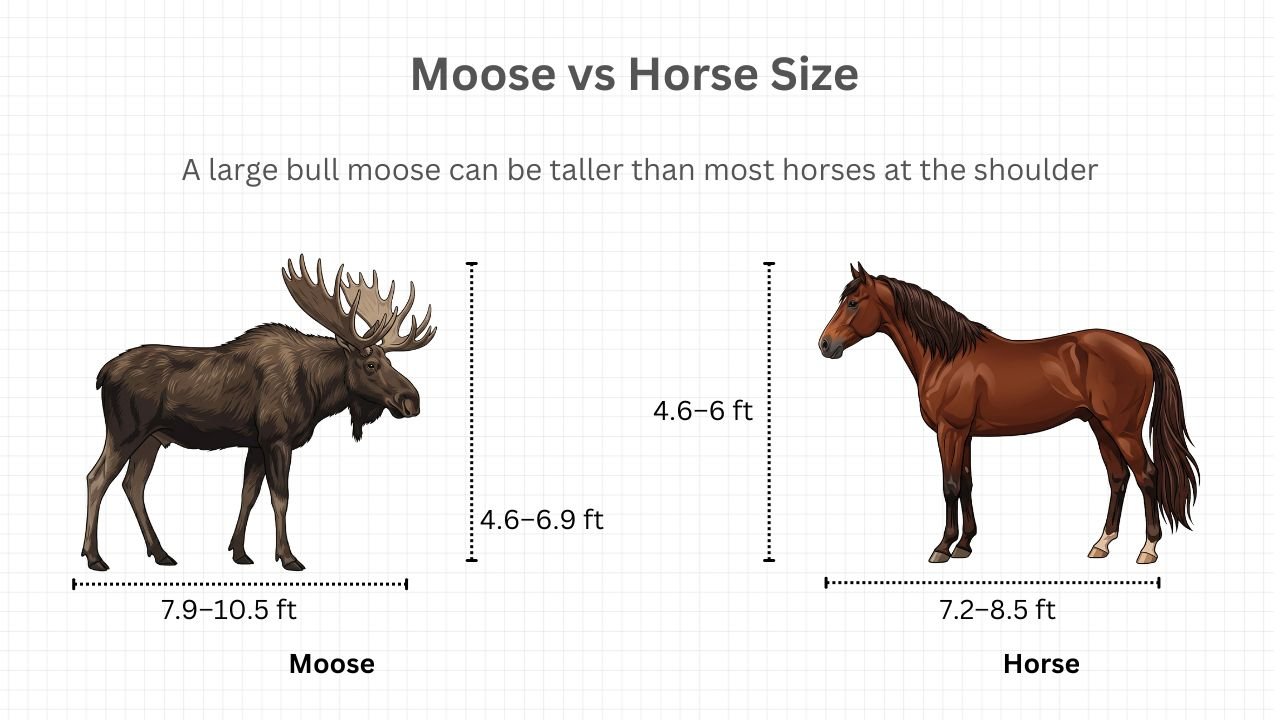
| Shoulder Height | 1.4–2.1 m (4.6–6.9 ft) | 1.4–1.8 m (4.6–6 ft) |
| Body Length | 2.4–3.2 m (7.9–10.5 ft) | 2.2–2.6 m (7.2–8.5 ft) |
| Average Weight (Male) | 380–700 kg (840–1,540 lbs) | 380–1,000 kg (840–2,200 lbs) |
| Maximum Recorded Weight | ~825 kg (1,820 lbs) | ~1,300 kg (2,860 lbs) — draft breeds |
| Leg Length | Extremely long relative to body | Long, proportional |
| Neck | Short, heavy, humped | Long, arched, elegant |
The comparison is closer than most people expect — and in some categories, the moose actually wins. At its tallest, a bull moose can stand taller at the shoulder than most horses, and its sheer body bulk rivals many large horse breeds. However, the heaviest draft horses — like the Shire and Belgian — outweigh even the largest moose by a significant margin.
Height Comparison: Moose vs Horse
This is where the moose genuinely shocks people.
A large bull moose can stand up to 2.1 meters (6.9 feet) at the shoulder — that’s nearly 7 feet tall at the withers, without even accounting for its enormous head and antlers. Add the antlers — which can span up to 1.8 meters (6 feet) across — and the total height of a standing moose with its head raised can exceed 3 meters (nearly 10 feet).
The average horse stands between 1.4–1.7 meters (14–17 hands) at the shoulder for common riding breeds like Thoroughbreds, Quarter Horses, and Arabians. Even large draft breeds like the Shire horse typically max out around 1.9 meters (18.2 hands).
Winner on height: Large bull moose, in many cases. An Alaskan bull moose is one of the tallest land animals in North America — taller at the shoulder than most horses you’ll ever encounter.
Weight Comparison: Moose vs Horse
Here the picture changes depending on the breed of horse.
A bull moose typically weighs between 380–700 kg, with large Alaskan subspecies reaching up to 825 kg (1,820 lbs). Cow moose are lighter, ranging from 200–360 kg.
A typical riding horse (Thoroughbred, Quarter Horse, Arabian) weighs around 380–550 kg — putting it squarely in moose territory. However, heavy draft breeds tell a different story entirely. Shire horses, Belgian Drafts, and Clydesdales can weigh 900–1,300 kg — significantly outweighing even the largest bull moose.
| Horse Breed | Average Weight | vs. Bull Moose |
|---|---|---|
| Arabian | 380–450 kg | Lighter than moose |
| Thoroughbred | 450–550 kg | Comparable |
| Quarter Horse | 430–545 kg | Comparable |
| Warmblood | 500–700 kg | Comparable to large moose |
| Clydesdale | 820–1,000 kg | Heavier than moose |
| Shire Horse | 850–1,100 kg | Heavier than moose |
| Belgian Draft | 900–1,100 kg | Heavier than moose |
Winner on weight: Draft horse breeds for maximum weight; typical riding horses and bull moose are surprisingly evenly matched.
Physical Build: Two Very Different Giants
Despite their similar size ranges, moose and horses are built in completely different ways — and those differences are immediately obvious up close.
The Moose
The moose has an almost prehistoric appearance — a massive, humped shoulder, a huge drooping snout called a dewlap (or bell) hanging from the throat, extremely long legs relative to its body, and a short neck that sits low and forward. Its body is deep and barrel-shaped, but its legs are so long that it can wade chest-deep in rivers and lakes with ease. The bull moose carries a massive rack of palmate antlers — broad, flat, and branching — that can weigh up to 36 kg (80 lbs) on their own. Moose also have a distinctive hump over the shoulders formed by elongated vertebrae — not unlike a bison’s.
The Horse
The horse is a study in athletic proportion — a long, arched neck, deep chest, muscular hindquarters, and elegant slender legs designed for speed and endurance. Where the moose looks built for power and swamp-wading, the horse looks built for running. The horse’s head is long and refined compared to the moose’s enormous, almost comically oversized snout. Horses carry no antlers, no dewlap, and no shoulder hump — giving them a cleaner, more streamlined silhouette.
Speed: Who’s Faster?
| Animal | Trotting Speed | Top Speed |
|---|---|---|
| Moose 🫎 | ~30 km/h | ~55–56 km/h (35 mph) |
| Horse 🐴 | ~20 km/h | ~70–88 km/h (43–55 mph) |
Horses are significantly faster than moose at top speed. A Thoroughbred racehorse can reach nearly 90 km/h at full gallop — among the fastest land animals on Earth over short distances. However, a moose is no slow lumberer — capable of 55–56 km/h at full run, which is fast enough to outpace most humans by a wide margin and sustain a trot through dense forest terrain that would slow any horse. Moose are also exceptional swimmers, capable of crossing wide rivers and lakes — a skill horses can manage but are far less adapted for.
Antlers: The Moose’s Defining Size Feature
No size comparison between moose and horses would be complete without addressing the moose’s most dramatic feature — its antlers.
- Adult bull moose antlers span up to 1.8 meters (6 feet) across
- They can weigh up to 36 kg (80 lbs)
- They are shed and regrown every single year — making them the fastest-growing tissue of any animal on Earth
- During the velvet growth phase, moose antlers grow at up to 2.5 cm (1 inch) per day
No horse carries anything remotely comparable. The antlers alone add an extraordinary visual bulk to the moose that makes it appear even more massive than its shoulder height and weight suggest — especially when a bull raises its head during the rut.
Moose vs Horse: Temperament & Danger
Horses have been domesticated for approximately 5,500 years and are generally calm, trainable, and human-friendly with proper handling.
Moose are wild, unpredictable, and genuinely dangerous. Despite their slow, lumbering appearance, moose are responsible for more attacks on humans in North America than bears — particularly during rutting season (fall) and when cows are protecting calves (spring). An agitated moose will charge without warning, kick with devastating force from all four legs, and can cause serious injury or death. Wildlife experts consistently advise: if you encounter a moose, give it far more space than you’d give a bear.
Habitat & Range
Moose are found across the boreal forests, wetlands, and tundra of Canada, Alaska, Scandinavia, Russia, and parts of the northern United States. They thrive in cold climates and are highly dependent on aquatic vegetation — regularly wading into lakes and rivers to feed on underwater plants.
Horses in their domestic form are found globally across every continent except Antarctica. Wild horse populations (mustangs, Przewalski’s horses) are found in specific regions of North America and Central Asia. Horses prefer open grasslands and plains — the opposite of the moose’s dense forest and wetland habitat.
Head-to-Head Summary
| Category | Moose 🫎 | Horse 🐴 |
|---|---|---|
| Max shoulder height | ✅ Up to 2.1 m | Up to 1.9 m (drafts) |
| Max weight | Up to ~825 kg | ✅ Up to ~1,300 kg (drafts) |
| Body length | ✅ Slightly longer | Slightly shorter |
| Top speed | ~56 km/h | ✅ ~88 km/h |
| Swimming ability | ✅ Excellent | Moderate |
| Antlers/horns | ✅ Massive rack | ❌ None |
| Domesticated | ❌ Wild animal | ✅ 5,500+ years |
| Danger to humans | ✅ High (wild) | Low (domestic) |
Key Takeaways
- A large bull moose can be taller than most horses at the shoulder
- Draft horses are heavier than moose; riding horses are comparable in weight
- Moose are longer-bodied than most horse breeds
- Horses are significantly faster at top speed
- Moose are surprisingly dangerous — more attacks on humans than bears annually
- Both animals are among the largest hoofed mammals on Earth
Conclusion
The moose vs horse size comparison delivers a result that surprises almost everyone — these two animals are far closer in size than most people assume, and in raw height, the bull moose actually edges out most horse breeds. While the heaviest draft horses outweigh even the biggest moose, the typical riding horse and a large bull moose are remarkably evenly matched in overall bulk and stature.
What truly separates them is not size but nature — the horse is one of humanity’s oldest and most valued partners, shaped by millennia of domestication, while the moose remains a wild, unpredictable, and awe-inspiring giant of the northern wilderness. Both deserve enormous respect — but for very different reasons.