A1 vs. B1 Paper Size: What’s the Real Difference?
When it comes to printing, architecture, or art, choosing the right canvas is about more than just “big” or “small.” The ISO 216 standard gives us two distinct families: the A series (the office and commercial standard) and the B series (the intermediate “bridge” sizes).
While A1 is a household name in the poster world, B1 is the secret weapon of professional printers. Here is everything you need to know about how they compare.
The Core Dimensions
The most fundamental difference is the physical footprint. The B series was designed specifically to provide sizes that fall between the A series steps.
| Feature | A1 Paper Size | B1 Paper Size |
| Dimensions (mm) | 594 x 841 mm | 707 x 1000 mm |
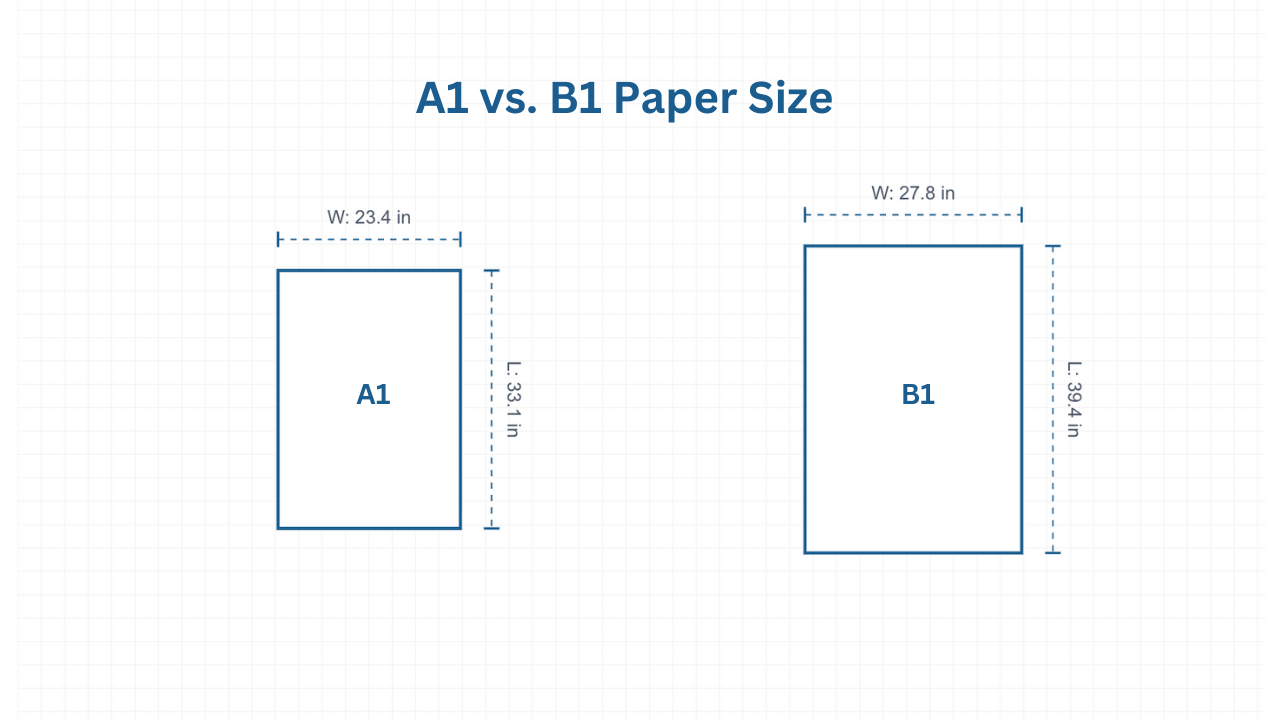
| Dimensions (inches) | 23.4 x 33.1 in | 27.8 x 39.4 in |
| Total Area | 0.5 sq m | 0.707 sq m |
Key Differences: Why Choose One Over the Other?
1. The “Middle Ground” Philosophy
The A series starts with A0, which is exactly 1 square meter. Every size after that is half the area of the previous one.
The B series exists because sometimes A1 is too small, but A0 is way too big. B1 is roughly 40% larger than A1, providing a substantial increase in surface area without becoming unmanageable for handheld viewing or standard framing.
2. Printing and Trimming
In the professional printing world, B1 is often the preferred choice for “offset” printing.
- A1 is a “finished” size. If you print an A1 design on an A1 sheet, you have no room for “bleed” (the image extending past the edge to ensure no white borders).
- B1 is frequently used as the sheet size for printing A1 posters. This allows printers to fit the A1 design in the center with plenty of room for crop marks and color bars, which are then trimmed off to create a perfect edge.
3. Common Use Cases
- A1 is for: Standard movie posters, flip charts, architectural blueprints, and retail window displays. It fits into most standard frames found in home decor stores.
- B1 is for: High-end advertising, maps, and large-scale technical drawings where extra detail is required. Because of its 1000mm (1 meter) height, it is a very satisfying size for symmetrical graphic design.
Which One Should You Use?
Choose A1 if… You are looking for cost-efficiency and easy framing. It is the standard for most commercial plotters and office printers.
Choose B1 if… You want a more “heroic” scale for your artwork or if you are a professional designer who needs the extra margin space for high-quality bleed and trimming.