74x Smaller but Still Winning? Israel vs Iran Size & Military Compared
Introduction
When people search for Israel vs Iran size, they’re often surprised by just how dramatic the difference is. These two nations — locked in one of the most closely watched geopolitical rivalries on the planet — are wildly different in terms of physical size, population, and geographic reach. Yet despite the enormous size gap, Israel remains one of the most powerful nations in the region.
In this blog, we’ll break down everything you need to know about Israel vs Iran size, covering land area, population, geography, and military defense strength.
Israel vs Iran Size: Land Area Comparison
| Factor | Israel 🇮🇱 | Iran 🇮🇷 |
|---|---|---|
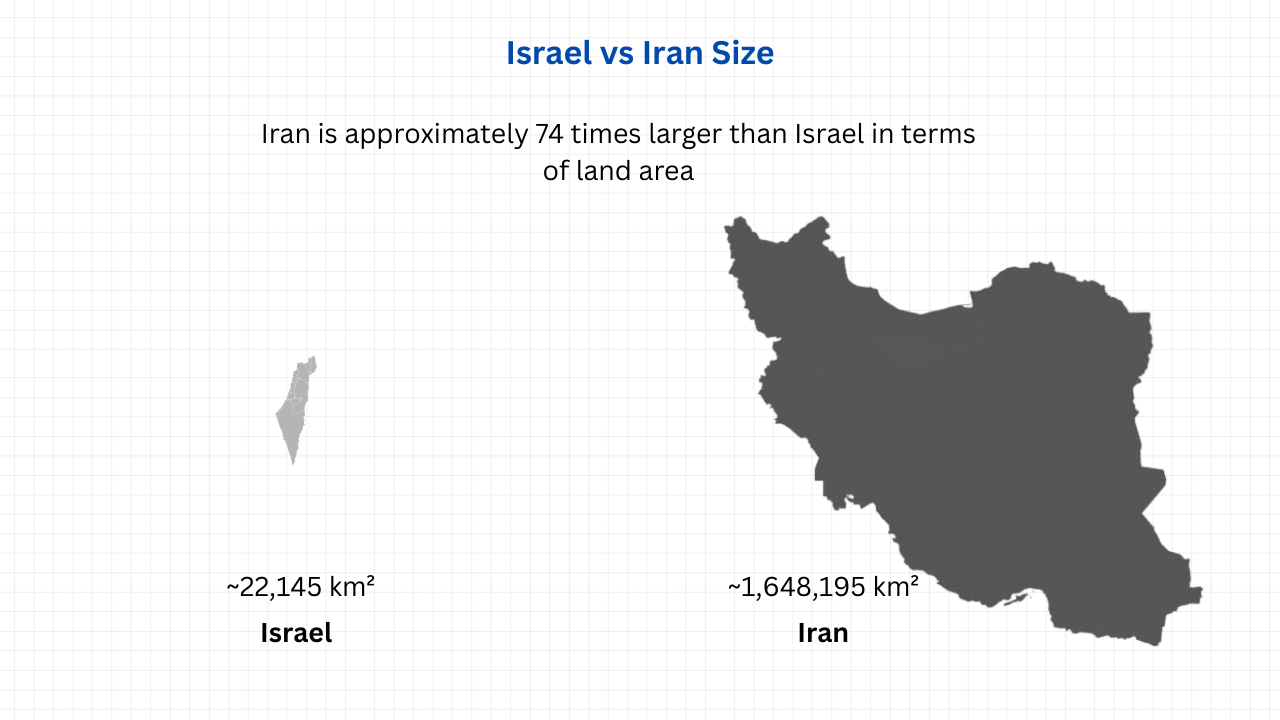
| Total Land Area | ~22,145 km² | ~1,648,195 km² |
| World Ranking (size) | ~153rd | 17th |
| Coastline | Mediterranean + Red Sea | Persian Gulf + Caspian Sea |
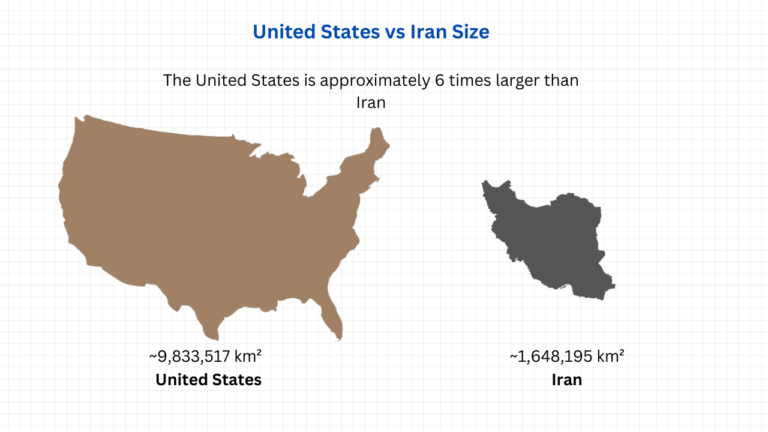
Iran is approximately 74 times larger than Israel in terms of land area. To put that into perspective, Iran is bigger than Western Europe combined, while Israel is roughly the size of New Jersey in the United States — or smaller than Wales in the UK.
Despite this vast size difference, Israel punches far above its weight in nearly every strategic metric.
Geographic Overview: Israel
Israel is a small but geographically diverse country situated at the crossroads of Europe, Asia, and Africa. It stretches roughly 470 km from north to south and only 135 km at its widest point.
Key geographic highlights:
- The Negev Desert covers more than half of Israel’s total land area
- The Coastal Plain along the Mediterranean is where most of the population lives
- The Golan Heights in the north offer strategic military elevation
- Israel has access to two seas: the Mediterranean in the west and the Red Sea (Gulf of Aqaba) in the south
Despite being tiny, Israel’s terrain provides significant strategic defensive advantages, with natural barriers on multiple sides.
Geographic Overview: Iran
Iran is a massive country in Southwest Asia, bordered by Iraq, Turkey, Armenia, Azerbaijan, Turkmenistan, Afghanistan, Pakistan, and the waters of the Persian Gulf, Gulf of Oman, and Caspian Sea.
Key geographic highlights:
- The Iranian Plateau forms the core of the country, averaging 1,200 meters in elevation
- The Zagros Mountains run along the west, creating natural barriers
- The Alborz Mountain Range includes Mount Damavand — the highest peak in the Middle East at 5,610 m
- Iran controls the Strait of Hormuz, through which roughly 20% of the world’s oil supply passes
Israel vs Iran Population Size
| Factor | Israel 🇮🇱 | Iran 🇮🇷 |
|---|---|---|
| Population (2025 est.) | ~9.8 million | ~90 million |
| Population Density | ~450/km² | ~55/km² |
| Urban Population | ~93% | ~77% |
| GDP Per Capita | ~$54,000 | ~$5,000–6,000 |
Iran’s population is roughly 9 times larger than Israel’s. However, Israel’s population is highly educated, urbanized, and technologically advanced, which translates directly into economic and military capability. Israel’s GDP per capita is significantly higher than Iran’s — largely due to international sanctions that have battered the Iranian economy.
Israel vs Iran Economy & Resources
Iran possesses massive natural resources — it holds among the world’s largest proven oil and natural gas reserves. However, decades of international sanctions have significantly stunted economic growth and limited defense modernization.
Israel lacks natural resources in comparison, but its knowledge economy, high-tech sector, and global trade relationships make it economically dominant on a per-capita basis. Israel is often called the “Startup Nation,” with one of the highest concentrations of tech startups per capita in the world.
Israel vs Iran Defence & Military Power
This is where the comparison becomes especially compelling. Despite Israel being 74 times smaller, its military capability rivals — and in many areas surpasses — Iran’s.
Israel Defense Forces (IDF)
The IDF is widely considered one of the most advanced and battle-tested militaries in the world.
- Active Personnel: ~170,000 soldiers; ~465,000 reservists
- Nuclear Capability: Israel is widely believed to possess nuclear weapons (neither confirmed nor denied — the “Ambiguity Policy”)
- Air Force: Operates F-35I Adir stealth jets, F-16s, and advanced drones — among the most capable air forces in the region
- Iron Dome: Israel’s multi-tiered missile defense system has an interception rate of over 90% against short-range rockets and artillery
- Arrow & David’s Sling: Can intercept ballistic missiles and cruise missiles at various altitudes, providing a layered shield over the entire country
- Cyber Warfare: Unit 8200 of the IDF is globally recognized as a world-class cyber intelligence and offense unit, comparable to the NSA
- Mossad: One of the most effective intelligence agencies in the world, with a proven record of covert operations deep inside adversarial territory
- Defense Budget: ~$23–27 billion/year, supplemented by significant U.S. military aid
Israel’s strategic doctrine is built on deterrence, preemption, and rapid decisive action — leveraging technological superiority to compensate for its small size and population.
Iranian Armed Forces
Iran’s military is massive in numbers but faces significant challenges due to aging equipment and international sanctions.
- Active Personnel: ~525,000–610,000 (including the IRGC)
- IRGC (Islamic Revolutionary Guard Corps): A parallel military force with enormous political power; controls Iran’s ballistic missile and drone programs
- Ballistic Missiles: One of the largest and most diverse ballistic missile arsenals in the Middle East — including the Shahab-3, Sejjil, and Fattah hypersonic missiles capable of striking targets across the region
- Drone Warfare: Iran has developed and mass-produced Shahed-series kamikaze drones, becoming one of the world’s leading drone exporters
- Navy: Operates fast-attack boats, submarines, and mine-laying vessels in the Persian Gulf and Strait of Hormuz — capable of disrupting global oil trade
- Proxy Network: Iran’s greatest strategic asset is its vast network of armed proxies — Hezbollah (Lebanon), Hamas (Gaza), Houthis (Yemen), and various Iraqi militias — collectively known as the “Axis of Resistance,” which extends Iran’s reach across the entire Middle East
- Nuclear Program: Iran is widely assessed to be at or near nuclear breakout capability — a central concern for both Israel and the international community
- Defense Budget: ~$10–15 billion/year
Iran’s strategy relies on asymmetric warfare, proxy forces, and strategic depth — using its vast geography and network of allies to deter and overwhelm adversaries.
Head-to-Head Military Comparison
| Category | Israel 🇮🇱 | Iran 🇮🇷 |
|---|---|---|
| Active Military | ~170,000 | ~525,000+ |
| Reservists | ~465,000 | ~350,000 |
| Nuclear Capability | Assumed (undeclared) | Near-breakout |
| Air Superiority | ✅ F-35, F-16 | ❌ Aging fleet |
| Missile Defense | ✅ Iron Dome, Arrow, David’s Sling | Limited |
| Ballistic Missiles | Medium range | ✅ Massive arsenal |
| Drone Program | ✅ Advanced offensive + surveillance | ✅ Shahed mass production |
| Cyber Warfare | ✅ World-class | Growing capability |
| Proxy Network | Limited | ✅ Extensive (Hezbollah, Houthis, etc.) |
| Defense Budget | ~$23B+/year | ~$10–15B/year |
| Global Arms Support | ✅ USA, NATO allies | Russia, North Korea (limited) |
Why Size Matters Less Than You Think
The Israel vs Iran size comparison proves one crucial geopolitical truth: physical size is not the same as power.
Israel’s strategic advantages:
- Technological superiority in air, sea, and cyber domains
- Nuclear deterrence — the ultimate equalizer
- Deep U.S. alliance — unparalleled access to hardware and intelligence sharing
- Compact geography — rapid force mobilization and full air coverage
- Mandatory military service creating a large, well-trained reserve force
Iran’s strategic advantages:
- Sheer geographic depth — nearly impossible to occupy or decisively defeat conventionally
- Massive ballistic missile arsenal capable of reaching all of Israel
- Proxy network creating simultaneous multi-front pressure
- Vast natural resources when sanctions are eased
- Large manpower pool
Conclusion
The Israel vs Iran size comparison is one of the most fascinating case studies in modern geopolitics. A tiny nation of under 10 million people has built a military and economic powerhouse that commands global attention, while Iran — a vast country with massive resources — leverages proxies, missiles, and asymmetric tactics to project power across the region.
Both nations are locked in a strategic rivalry that will define the Middle East for decades to come. Size alone tells only a small part of the story — technology, alliances, doctrine, and will are what truly determine power.