Spinosaurus vs T-Rex: Size, Bite Force & Who Would Win in a Fight
Introduction
Few questions in paleontology spark more debate than Spinosaurus vs T-Rex size. For decades, the Tyrannosaurus Rex stood unchallenged as the king of the dinosaurs — the largest, most fearsome land predator that ever lived. Then Spinosaurus entered the picture and rewrote the record books entirely.
In this detailed blog, we’ll break down everything known about Spinosaurus vs T-Rex size — length, weight, skull, teeth, arms, speed, diet, habitat, and the ultimate question: who would win if they ever met? Whether you’re a dinosaur enthusiast, a student, or just someone who watched Jurassic Park III and couldn’t stop thinking about it — this guide has everything you need.
Spinosaurus vs T-Rex Size: The Core Numbers
| Measurement | Spinosaurus | T-Rex |
|---|---|---|
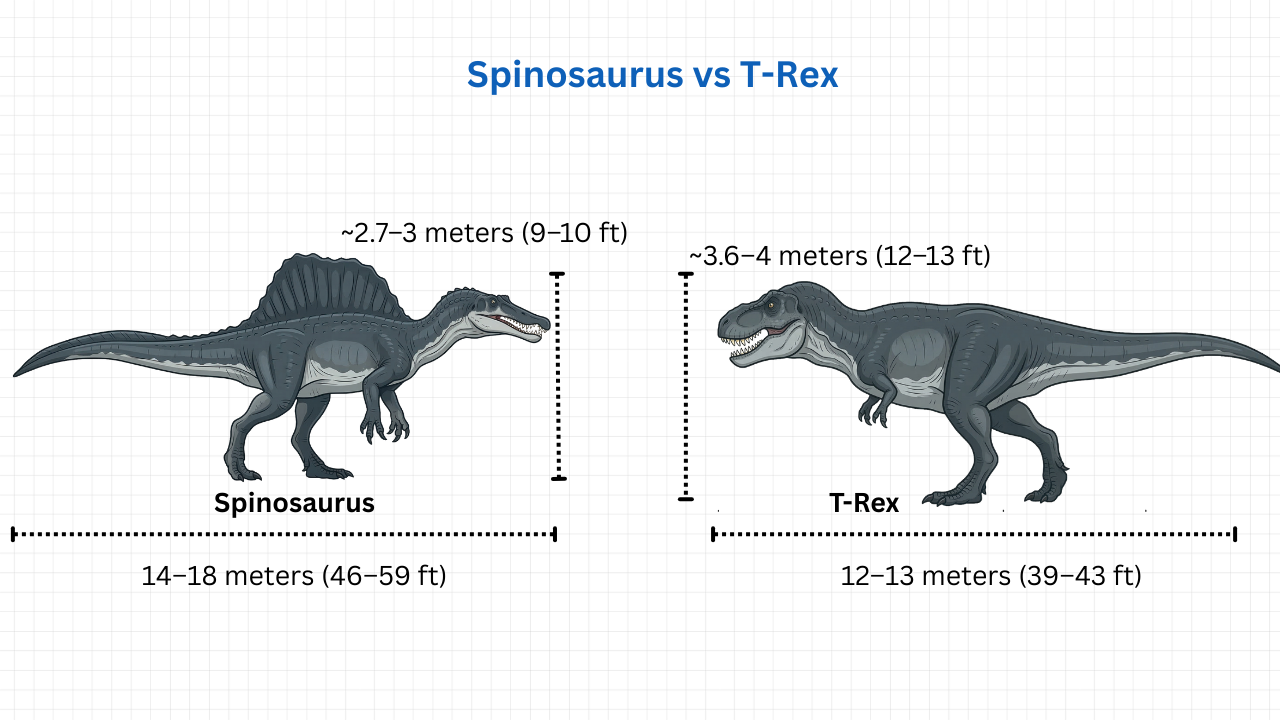
| Estimated Length | 14–18 meters (46–59 ft) | 12–13 meters (39–43 ft) |
| Estimated Height (at hips) | ~2.7–3 meters (9–10 ft) | ~3.6–4 meters (12–13 ft) |
| Estimated Weight | 7,000–20,000 kg (15,000–44,000 lbs) | 8,000–14,000 kg (17,600–30,800 lbs) |
| Skull Length | ~1.5–1.75 meters (5–5.7 ft) | ~1.5 meters (5 ft) |
| Time Period | Cretaceous (~95–100 MYA) | Late Cretaceous (~66–68 MYA) |
| Location | North Africa | North America |
The headline finding: Spinosaurus was longer than T-Rex — potentially by several meters — making it the longest known carnivorous dinosaur to have ever lived. However, the comparison is more nuanced than a single number, because these two giants had very different body plans, lifestyles, and ecological roles.
The Spinosaurus: Everything We Know
Spinosaurus (Spinosaurus aegyptiacus — “Egyptian spine lizard”) is one of paleontology’s most fascinating and controversial dinosaurs. First discovered in Egypt in 1912 by German paleontologist Ernst Stromer, the original fossils were tragically destroyed in a World War II Allied bombing raid on Munich in 1944. New, remarkable fossils discovered in Morocco’s Kem Kem region in 2008 and 2014 have dramatically reshaped our understanding of this animal.
Physical Description
- Length: Current estimates range from 14 to 18 meters (46–59 feet), with most researchers settling on around 15–16 meters for the best-known specimens. This makes Spinosaurus the longest carnivorous dinosaur ever discovered — surpassing both T-Rex and Giganotosaurus
- The Neural Spines (Sail/Hump): Spinosaurus’s most iconic feature — elongated vertebral spines rising up to 1.65 meters (5.4 ft) from the backbone. Scientists debate whether these formed a tall, thin sail (like a marlin’s fin) or a thick, muscular hump (like a bison). Recent research increasingly favors the hump hypothesis, suggesting it was a fat and muscle storage structure used in semi-aquatic environments
- Skull: Long, narrow, and crocodile-like — measuring up to 1.75 meters and lined with conical, interlocking teeth perfectly adapted for catching slippery fish. The nostrils are positioned high on the skull — an adaptation for an animal that spent significant time with its head in water
- Arms: Proportionally much larger and more functional than T-Rex’s arms — with strong, curved claws ideal for hooking fish from the water
- Legs: Recent fossil analysis has dramatically revised our view of Spinosaurus locomotion. The legs appear shorter and denser than typical large theropods, and the feet show paddle-like adaptations — suggesting Spinosaurus was primarily a quadrupedal or semi-aquatic wader rather than an upright biped like T-Rex
- Tail: A 2020 Nature study revealed Spinosaurus had a broad, paddle-like tail — the first dinosaur known to have such an adaptation — confirming it was a capable swimmer that actively pursued prey underwater
The Tyrannosaurus Rex: Everything We Know
Tyrannosaurus Rex (Tyrannosaurus rex — “tyrant lizard king”) needs little introduction. It is the most studied, most recognized, and arguably most scientifically important dinosaur ever discovered. More than 50 T-Rex specimens have been found — giving paleontologists an extraordinary amount of data compared to most other large theropods.
Physical Description
- Length: Between 12–13 meters (39–43 feet) for the largest confirmed specimens. The famous “Sue” specimen at the Field Museum in Chicago measures 12.3 meters. “Scotty,” discovered in Saskatchewan, is estimated to have been around 13 meters and is considered the largest T-Rex yet found
- Height: T-Rex stood approximately 3.6–4 meters (12–13 feet) at the hip — significantly taller than Spinosaurus despite being shorter overall, due to its more upright posture and powerful vertical build
- Mass: Estimates for large individuals range from 8,000 to 14,000 kg — making T-Rex one of the heaviest land predators ever, with a denser, more powerfully built body than the longer but lower-slung Spinosaurus
- Skull: A massive, wide, reinforced skull up to 1.5 meters long — built like a biological battering ram and designed to withstand the enormous forces generated by its bite
- Teeth: Unlike Spinosaurus’s conical fish-catching teeth, T-Rex had large, banana-shaped, serrated teeth — the largest of any carnivorous dinosaur, up to 30 cm (12 inches) long including the root. These were bone-crushing weapons, not flesh-slicing tools
- Arms: Famously tiny — only about 1 meter (3 feet) long relative to its body size. Despite their reputation, T-Rex arms were muscular and may have been used to grip prey or help the animal rise from the ground. But compared to Spinosaurus, they were functionally minimal
- Legs: Massive, pillar-like legs built for power and stability rather than speed. T-Rex was a pursuit predator that relied on short, explosive bursts of speed rather than endurance
Direct Size Comparison: Spinosaurus vs T-Rex
Length
Spinosaurus wins decisively. At 14–18 meters vs T-Rex’s 12–13 meters, Spinosaurus was the longer animal by a meaningful margin — potentially 3–5 meters longer in the largest estimates. In terms of sheer body length, no carnivorous dinosaur known to science exceeded Spinosaurus.
Height
T-Rex wins. Despite being shorter in total body length, T-Rex stood taller at the hips — around 3.6–4 meters vs Spinosaurus’s estimated 2.7–3 meters. T-Rex’s fully upright bipedal stance and massive vertical torso made it a taller, more imposing animal when face to face.
Weight
Closely contested — T-Rex may have been heavier. Despite Spinosaurus being longer, T-Rex had a denser, more robust build with a far heavier skull and thicker bones. Most estimates give large T-Rex individuals a mass of 8,000–14,000 kg vs Spinosaurus at 7,000–20,000 kg — though the upper Spinosaurus estimates are considered speculative. For typical large individuals, the two were roughly comparable in mass, with T-Rex possibly edging ahead.
Skull & Bite Force
T-Rex wins by an enormous margin. This is perhaps the starkest difference between the two giants. T-Rex had a bite force of approximately 35,000–57,000 Newtons — the most powerful bite force of any land animal ever measured or estimated. Spinosaurus’s narrow, crocodile-like skull was built for a completely different purpose — speed and grip for catching fish — and its bite force was dramatically lower, estimated at around 7,000–10,000 Newtons. T-Rex could crush bone; Spinosaurus could not.
Skull, Teeth & Bite Force Comparison
| Feature | Spinosaurus | T-Rex |
|---|---|---|
| Skull Shape | Long, narrow, crocodilian | Wide, massive, reinforced |
| Skull Length | ~1.5–1.75 m | ~1.5 m |
| Teeth Shape | Conical, interlocking | Serrated, banana-shaped |
| Tooth Length | Up to 12 cm | Up to 30 cm (with root) |
| Bite Force | ~7,000–10,000 N | ~35,000–57,000 N |
| Can Crush Bone? | ❌ No | ✅ Yes |
| Adapted For | Fish, aquatic prey | Large dinosaurs, bone |
Arms, Claws & Combat Weapons
| Feature | Spinosaurus | T-Rex |
|---|---|---|
| Arm Length | ~1.5 meters — functional | ~1 meter — small |
| Claws | Large, curved — hook-like | Smaller but present |
| Primary Weapons | Claws + teeth | Skull + jaws |
| Combat Style | Slash and grip | Crush and bite |
Spinosaurus had genuinely large, powerful forelimbs tipped with curved, hook-like claws — excellent for pinning fish and potentially slashing at threats. T-Rex’s arms, while famously small, were densely muscled — studies suggest they could curl several hundred kilograms — but they were too short to reach prey without the head doing the primary work.
Speed & Movement
| Feature | Spinosaurus | T-Rex |
|---|---|---|
| Locomotion | Semi-quadrupedal/aquatic | Fully bipedal |
| Estimated Top Speed | ~15–20 km/h on land | ~17–20 km/h |
| Swimming | ✅ Confirmed capable | ❌ Not adapted |
| Terrain | Rivers, swamps, shorelines | Open floodplains, forests |
Neither dinosaur was particularly fast by modern animal standards — both were too large for sustained rapid movement. Spinosaurus’s aquatic adaptations actually made it less efficient on land than T-Rex, with its shorter legs and lower body position suggesting it was awkward away from water. In its aquatic element, however, Spinosaurus was likely a powerful and agile swimmer.
Diet & Hunting Behavior
| Feature | Spinosaurus | T-Rex |
|---|---|---|
| Primary Diet | Fish, aquatic prey, possibly carrion | Large dinosaurs (hadrosaurs, ceratopsians) |
| Hunting Style | Ambush wader / active swimmer | Active pursuit + ambush |
| Evidence | Fish bones in gut region, paddle tail | Bite marks on Triceratops, hadrosaur bones |
| Ecological Role | Semi-aquatic apex predator | Terrestrial apex predator |
This is a crucial point: Spinosaurus and T-Rex occupied completely different ecological niches. Spinosaurus was primarily a fish-eating, semi-aquatic predator — more comparable to a giant heron or crocodile in behavior than to T-Rex. T-Rex was a terrestrial apex predator that actively hunted the largest land dinosaurs of its era.
They were not competing for the same prey, living in the same habitat, or evolved for the same purpose — which makes a direct “who would win” comparison more complex than it first appears.
Did They Ever Meet?
No — they lived in completely different times and places.
- Spinosaurus lived approximately 95–100 million years ago in what is now North Africa (modern Morocco, Egypt, Tunisia)
- T-Rex lived approximately 66–68 million years ago in what is now North America
They were separated by roughly 30 million years and an entire ocean — making any real encounter impossible. The Jurassic Park III scene where Spinosaurus defeats T-Rex, while entertaining, is pure Hollywood fiction.
Who Would Win in a Fight? (Hypothetical)
This is the question everyone wants answered. Setting aside the geographical and temporal impossibility, if a fully grown Spinosaurus and a fully grown T-Rex somehow met on neutral terrestrial ground — who wins?
Most paleontologists and analysts favor T-Rex, and here’s why:
T-Rex’s advantages on land:
- Vastly superior bite force — 5–8 times more powerful than Spinosaurus’s bite
- Wider, stronger skull built to absorb and inflict enormous impacts
- More efficient bipedal movement on land — Spinosaurus was awkward away from water
- Reinforced skull could potentially withstand blows from Spinosaurus’s claws
- Bone-crushing teeth that could cause catastrophic damage in a single bite
Spinosaurus’s advantages:
- Longer body — potentially more reach
- Functional arms with large claws — could slash and grip
- Larger overall body in the most generous size estimates
- Could potentially escape into water — T-Rex could not follow effectively
The consensus is clear: on land, T-Rex wins. Its skull is a weapon Spinosaurus simply cannot match — one properly placed bite from T-Rex on Spinosaurus’s thinner, crocodile-like skull would likely be decisive. In water, Spinosaurus would have a significant advantage. But in a terrestrial encounter, T-Rex’s jaw was the most powerful weapon in the Cretaceous.
Fossil Discovery Timeline
| Year | Discovery | Significance |
|---|---|---|
| 1912 | First Spinosaurus fossils (Egypt) | Original description by Ernst Stromer |
| 1944 | Fossils destroyed in WWII bombing | Set back research by decades |
| 1902 | First T-Rex fossil (USA) | Discovered by Barnum Brown |
| 1990 | “Sue” T-Rex found (South Dakota) | Largest/most complete T-Rex at the time |
| 2008–2014 | New Spinosaurus fossils (Morocco) | Revealed aquatic adaptations, revised size |
| 2020 | Spinosaurus paddle-tail study (Nature) | Confirmed swimming capability |
| 2022 | “Scotty” declared largest T-Rex | ~13 meters, estimated 8,870 kg |
Key Takeaways: Spinosaurus vs T-Rex Size
- Spinosaurus was longer — up to 14–18 m vs T-Rex’s 12–13 m
- T-Rex was taller at the hips and had a denser, more robust build
- T-Rex had a bite force 5–8x more powerful than Spinosaurus
- Spinosaurus was a semi-aquatic fish eater; T-Rex was a terrestrial apex predator
- They never met — separated by 30 million years and different continents
- On land, T-Rex would likely win any confrontation
Conclusion
The Spinosaurus vs T-Rex size debate doesn’t have one single winner — it depends on what you’re measuring. Spinosaurus was the longer dinosaur and arguably the largest carnivore ever to walk the Earth. But T-Rex was taller, heavier in build, and possessed the most powerful bite of any land predator in history. They were two completely different evolutionary solutions to being a large predator — one ruling the rivers and shores of prehistoric Africa, the other dominating the forests and plains of ancient North America.
Both dinosaurs were extraordinary. Both were apex predators of their time and place. And both continue to fascinate scientists and the public more than a century after their first discovery — a testament to just how remarkable these ancient giants truly were.