6x Smaller but Still a Threat? USA vs Iran Size & Military Compared
Introduction
The question of USA vs Iran size reveals one of the starkest geopolitical contrasts on Earth. The United States is a superpower spanning an entire continent, while Iran, though a large and influential nation in its own right, is dramatically smaller. Yet Iran’s geographic position, massive missile arsenal, proxy network, and near-nuclear status make it a persistent strategic challenge for Washington.
In this detailed guide, we’ll explore everything about USA vs Iran size — land area, population, geography, economy, and military defense power — so you have a complete picture of how these two nations compare.
USA vs Iran Size: Land Area Comparison
| Factor | USA 🇺🇸 | Iran 🇮🇷 |
|---|---|---|
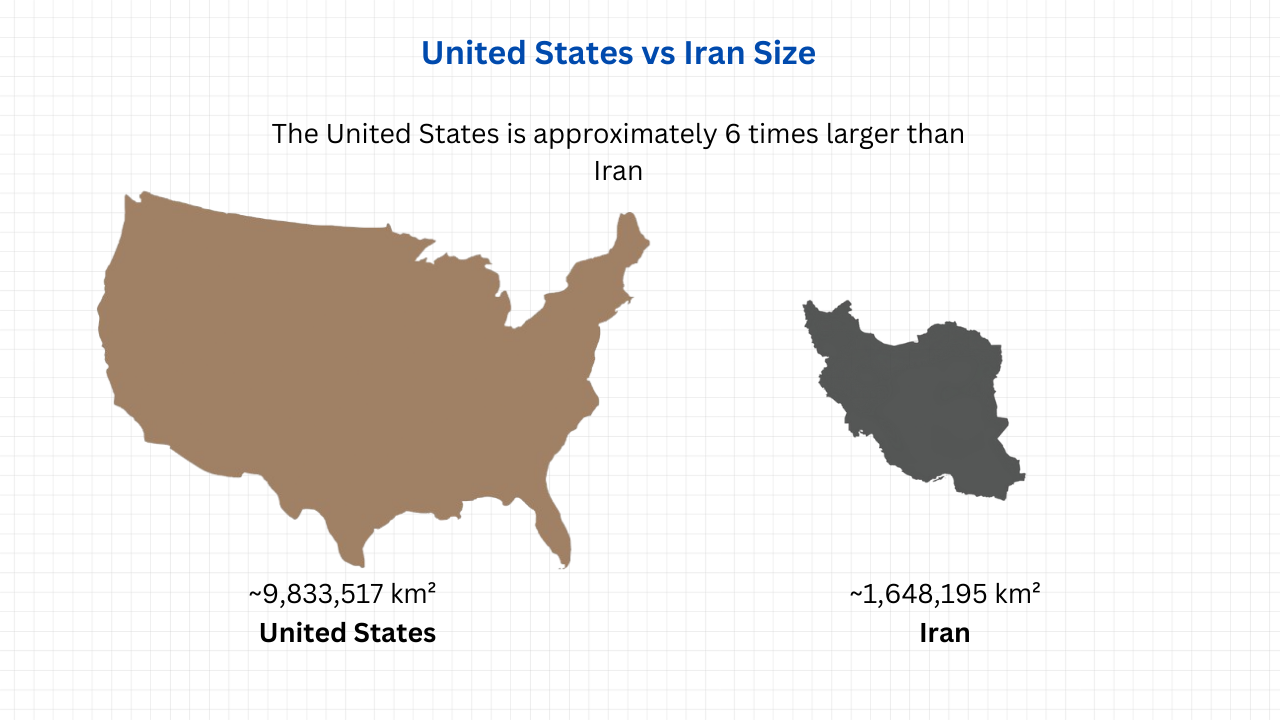
| Total Land Area | ~9,833,517 km² | ~1,648,195 km² |
| World Ranking (size) | 3rd (or 4th depending on method) | 17th |
| Continent | North America | Asia (Middle East) |
| Coastline Length | ~19,924 km | ~2,440 km |
| Time Zones | 6 | 1 |
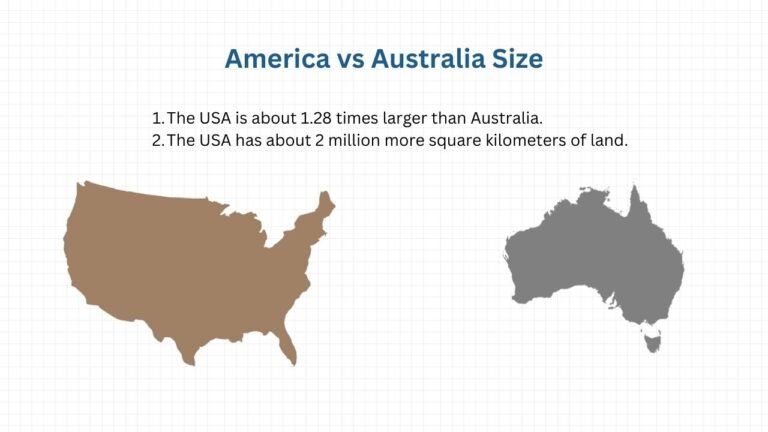
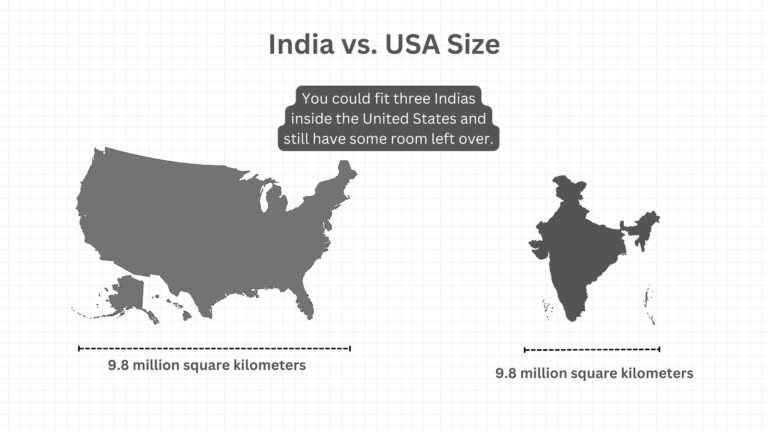
The United States is approximately 6 times larger than Iran in land area. The US spans an entire continent from the Atlantic to the Pacific Ocean, while Iran — though one of the largest countries in the Middle East — fits comfortably within a single US region.
To put it visually: Iran is roughly the size of Alaska alone, and the continental US (excluding Alaska and Hawaii) is still more than 4 times Iran’s total area.
Geographic Overview: United States
The United States is extraordinarily geographically diverse, spanning deserts, mountain ranges, vast plains, tropical regions, and arctic territories.
Key geographic highlights:
- The Rocky Mountains run the length of the western US, forming a massive natural barrier
- The Great Plains span the central US — among the most productive agricultural land on Earth
- The Mississippi River System is the 4th largest river drainage basin in the world
- The US controls access to both the Atlantic and Pacific Oceans, giving it unparalleled naval reach
- Alaska alone is nearly the same size as Iran, and Hawaii provides a strategic Pacific base
- The US shares land borders only with Canada and Mexico — two non-hostile neighbors — providing extraordinary geographic security
This geographic security is one reason the US has been able to build its economy and military without fear of land invasion for over two centuries.
Geographic Overview: Iran
Iran sits at a critical strategic crossroads in Southwest Asia, bordered by Iraq, Turkey, Armenia, Azerbaijan, Turkmenistan, Afghanistan, Pakistan, and the waters of the Persian Gulf, Gulf of Oman, and Caspian Sea.
Key geographic highlights:
- The Iranian Plateau dominates the interior, averaging 1,200 meters in elevation — making military operations difficult
- The Zagros Mountains in the west and the Alborz Range in the north create natural defensive walls
- Iran controls the Strait of Hormuz, the world’s most critical oil chokepoint — roughly 20% of global oil supply passes through it daily
- Major cities like Tehran, Isfahan, and Shiraz are deep inland — providing natural protection from coastal attack
- Iran’s diverse terrain — mountains, deserts, and forests — makes large-scale ground invasion extraordinarily difficult even for the world’s greatest military powers
USA vs Iran Population Size
| Factor | USA 🇺🇸 | Iran 🇮🇷 |
|---|---|---|
| Population (2025 est.) | ~340 million | ~90 million |
| Population Density | ~36/km² | ~55/km² |
| Urban Population | ~83% | ~77% |
| Median Age | ~38 years | ~33 years |
| Literacy Rate | ~99% | ~88% |
| Official Language | English (de facto) | Persian (Farsi) |
The United States has nearly 4 times the population of Iran. More importantly, the US population is among the most educated, wealthy, and productive in the world — directly fueling its defense and innovation capacity.
Iran’s population is young and growing, with a median age of 33, providing a large military manpower pool. However, economic hardship caused by decades of sanctions has led to significant brain drain, with many educated Iranians emigrating — weakening Iran’s long-term technological capacity.
USA vs Iran: Economy Comparison
| Factor | USA 🇺🇸 | Iran 🇮🇷 |
|---|---|---|
| GDP (2024 est.) | ~$28 trillion | ~$400–500 billion |
| GDP Per Capita | ~$82,000 | ~$5,000–6,000 |
| Global GDP Share | ~25% of world GDP | ~0.4% |
| Key Industries | Tech, finance, defense, energy | Oil, gas, petrochemicals |
| Currency Strength | World’s reserve currency (USD) | Severely devalued Rial |
The economic gap is staggering. The US economy is roughly 55–70 times larger than Iran’s GDP, depending on the year and sanctions status. The US dollar is the world’s reserve currency — giving the United States unmatched financial power to fund its military, foreign policy, and global alliances.
Iran’s economy, though rich in oil and gas reserves, has been crippled by decades of international sanctions linked to its nuclear program, regional proxy activities, and human rights record. Inflation in Iran has regularly exceeded 40–50% in recent years, gutting purchasing power and limiting defense modernization.
USA vs Iran Defence & Military Power
This is where the comparison becomes truly eye-opening. The US military is the most powerful conventional military force in human history, while Iran relies on asymmetric tactics, missile arsenals, and proxy networks to punch above its weight.
United States Military
The US Armed Forces are unmatched in capability, reach, and technology.
- Active Personnel: ~1.3 million active duty; ~800,000 reservists
- Defense Budget: ~$886 billion (FY2024) — more than the next 10 countries combined
- Nuclear Arsenal: ~5,500 nuclear warheads (1,700+ deployed) — one of the world’s two largest nuclear arsenals alongside Russia
- Air Force: The most powerful in the world — operates ~13,000 military aircraft including B-2 Spirit stealth bombers, F-22 Raptors, F-35 Lightning IIs, and AC-130 gunships
- Navy: 11 nuclear-powered aircraft carrier strike groups — more than the rest of the world combined; operates 68+ submarines
- Space Force: The world’s first dedicated space warfare branch, controlling satellite communications, GPS, and space-based surveillance
- Cyber Command (USCYBERCOM): One of the world’s most capable offensive and defensive cyber forces; co-responsible for Stuxnet — the cyberweapon that sabotaged Iran’s nuclear centrifuges
- Global Bases: The US maintains ~750+ military bases in over 80 countries — enabling power projection anywhere on Earth within hours
- Special Operations: USSOCOM deploys elite forces like Navy SEALs, Delta Force, and Army Rangers across the globe
- Alliances: Leads NATO (31 member nations), maintains treaty alliances with Japan, South Korea, Australia, and Israel
The US military doctrine is built around full-spectrum dominance — the ability to defeat any adversary simultaneously across land, sea, air, space, and cyberspace.
Iranian Armed Forces
Iran’s military is large in personnel but constrained by sanctions, aging equipment, and limited air power. However, Iran has developed clever asymmetric capabilities to offset these weaknesses.
- Active Personnel: ~525,000–610,000 (Army + IRGC combined)
- IRGC (Islamic Revolutionary Guard Corps): A powerful parallel military answering directly to the Supreme Leader; controls ballistic missiles, drones, and the Quds Force — which manages Iran’s proxy network abroad
- Defense Budget: ~$10–15 billion/year (estimates vary due to lack of transparency)
- Ballistic Missiles: Iran possesses one of the largest ballistic missile arsenals in the Middle East — including the Shahab-3 (range: 2,000 km+), Sejjil (solid-fuel, 2,500 km range), and the Fattah hypersonic missile (claimed Mach 13–15 speed), which Iran claims can evade existing missile defense systems
- Drone Warfare: Iran has emerged as a global drone power — the Shahed-136 and Shahed-238 kamikaze drones have been widely deployed and exported. Iran’s drone program is one of the most active in the world
- Navy: Iran’s navy is designed for asymmetric warfare in the Persian Gulf — using fast-attack boats, naval mines, and anti-ship missiles to threaten US carrier groups and oil tankers in the Strait of Hormuz
- Proxy Network: Iran’s most powerful strategic weapon is its “Axis of Resistance” — Hezbollah (Lebanon), Hamas (Gaza), the Houthis (Yemen), and multiple Iraqi Shia militias — giving Iran the ability to threaten Israel, Saudi Arabia, Gulf shipping, and US bases from multiple directions simultaneously
- Nuclear Program: Iran is assessed by the IAEA and US intelligence to be at or very near nuclear breakout capability — able to enrich enough uranium for a weapon within weeks if it chose to do so
- Cyber Warfare: Iran has developed significant offensive cyber capabilities — responsible for attacks on US banks, Saudi Aramco, and critical infrastructure across the region
Iran’s military strategy is not to match the US conventionally — that would be impossible — but to raise the cost of any US military action high enough to deter it. This is achieved through missiles that can close the Strait of Hormuz, proxy forces that threaten US allies and bases, and the implicit threat of nuclear escalation.
Head-to-Head Military Comparison: USA vs Iran
| Category | USA 🇺🇸 | Iran 🇮🇷 |
|---|---|---|
| Active Military | ~1.3 million | ~525,000–610,000 |
| Defense Budget | ~$886 billion | ~$10–15 billion |
| Nuclear Warheads | ~5,500 (1,700+ deployed) | Near-breakout (0 confirmed) |
| Aircraft Carriers | 11 nuclear-powered | 0 |
| Military Aircraft | ~13,000 | ~350–500 (aging) |
| Stealth Aircraft | ✅ B-2, F-22, F-35 | ❌ None |
| Submarines | 68+ (nuclear-capable) | ~19–29 (conventional) |
| Global Military Bases | 750+ in 80+ countries | Limited (Syria, Iraq presence) |
| Ballistic Missiles | ✅ ICBM arsenal | ✅ Large regional arsenal |
| Drone Capability | ✅ World-leading (Reaper, Global Hawk) | ✅ Shahed mass production |
| Cyber Warfare | ✅ World #1 (USCYBERCOM) | Growing capability |
| Proxy Forces | NATO + treaty allies | ✅ Hezbollah, Houthis, Hamas, Iraqi militias |
| Space Warfare | ✅ Dedicated Space Force | Limited |
Could Iran Ever Win a Conventional War Against the US?
The answer from any military analyst is a clear no — at least not in any traditional sense. The US outspends Iran on defense by roughly 60:1, operates the world’s most powerful air force and navy, and possesses thousands of nuclear weapons.
However, “winning” and “not losing” are different things. Iran’s strategy has never been to defeat the US military directly — it is to make any US military campaign so costly, prolonged, and regionally destabilizing that it becomes politically untenable. This is the same logic that makes insurgencies and asymmetric conflicts so difficult for conventional superpowers.
Iran’s ability to close the Strait of Hormuz (triggering a global oil crisis), activate Hezbollah against Israel, launch missiles at US bases across the Gulf region, and draw the US into a prolonged regional war — all without ever fighting a conventional set-piece battle — is what makes Iran a serious and enduring strategic challenge despite the massive size and power gap.
Key Takeaways: USA vs Iran Size
- The US is ~6 times larger than Iran in land area
- The US has ~4 times more people than Iran
- The US defense budget is ~60 times larger than Iran’s
- Iran compensates with ballistic missiles, drones, proxies, and asymmetric tactics
- Iran’s control of the Strait of Hormuz gives it outsized global leverage
- The nuclear question remains the central flashpoint in US-Iran relations
Conclusion
The USA vs Iran size comparison ultimately tells a story of overwhelming American advantage in almost every conventional metric — land, population, economy, and military power. Yet Iran has proven to be a uniquely resilient adversary, leveraging geography, asymmetric warfare, proxy forces, and nuclear ambiguity to maintain strategic relevance far beyond what its size and GDP would suggest.
Understanding this comparison is essential for anyone trying to make sense of Middle East geopolitics, global oil markets, and US foreign policy in the years ahead.