Pint vs Quart Size: What’s the Difference & How Do They Compare?
Introduction
Whether you’re cooking a recipe, buying ice cream, ordering a drink, or measuring paint — understanding pint vs quart size is one of those everyday measurement skills that makes a genuine difference. These two units of liquid volume show up constantly in kitchens, grocery stores, bars, and hardware stores — yet a surprising number of people aren’t entirely sure how they compare.
Is a quart twice a pint? Does a pint mean the same thing in the US and the UK? How do these fit into the bigger picture of cups, gallons, and liters? This guide answers all of it — clearly, completely, and with plenty of real-world examples to make it stick.
Pint vs Quart Size: The Core Numbers
Let’s start with the most important facts:
| Measurement | Pint (pt) | Quart (qt) |
|---|---|---|
| US Liquid Volume | 16 fl oz (473 ml) | 32 fl oz (946 ml) |
| UK / Imperial Volume | 20 fl oz (568 ml) | 40 fl oz (1,136 ml) |
| Relationship | 1 pint = ½ quart | 1 quart = 2 pints |
| In cups (US) | 2 cups | 4 cups |
| In tablespoons | 32 tbsp | 64 tbsp |
| In liters (approx.) | ~0.473 L | ~0.946 L |
| Abbreviation | pt | qt |
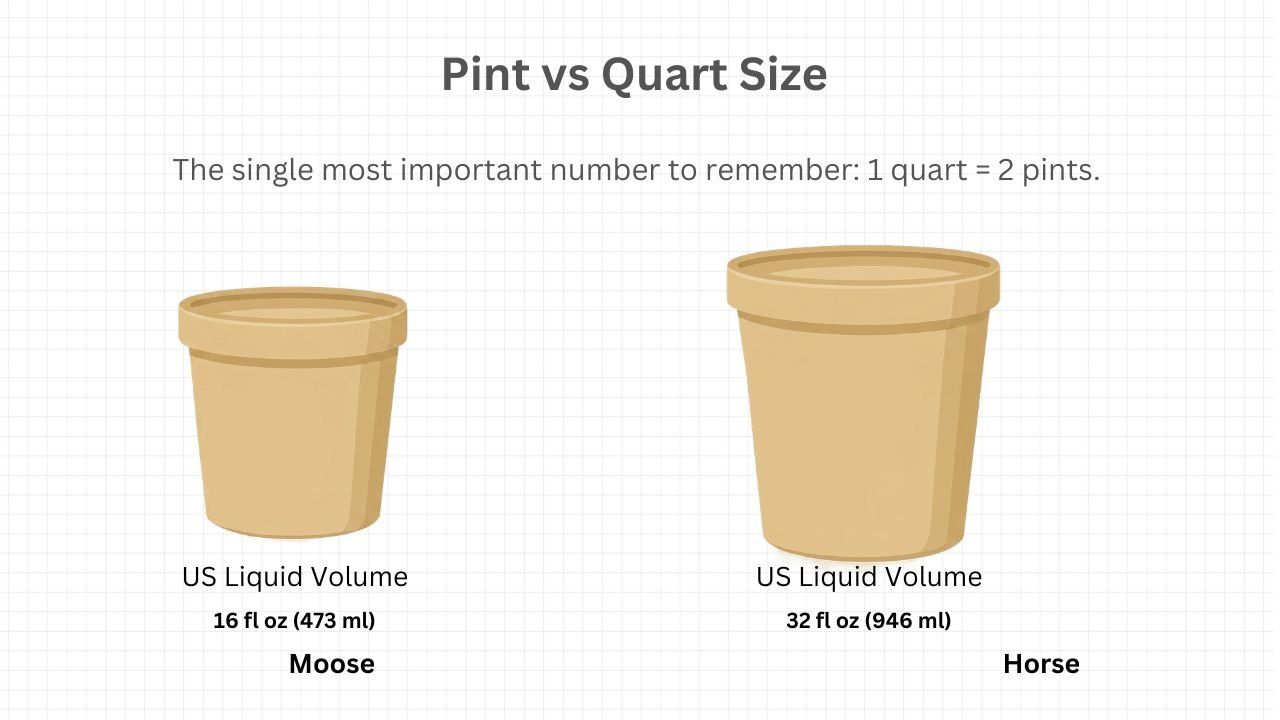
The single most important number to remember: 1 quart = 2 pints. A quart is exactly double the size of a pint — every single time, in every system of measurement. That one relationship is the foundation of everything else in this comparison.
What Is a Pint?
A pint is a unit of liquid volume used primarily in the United States, the United Kingdom, and countries influenced by the British imperial system. Despite sharing the same name, a US pint and a UK pint are not the same size — a fact that catches many people off guard.
US Pint
- 16 US fluid ounces
- 473 milliliters
- Equal to 2 US cups
- The standard size for a pint of ice cream, beer at a brewery, or blueberries at the grocery store
UK / Imperial Pint
- 20 imperial fluid ounces
- 568 milliliters
- Equal to 4 gills
- The standard pub serving of beer in the United Kingdom, Ireland, and Australia
- About 20% larger than a US pint
This difference matters enormously when following recipes from different countries or ordering drinks abroad. A UK pint of beer is genuinely a bigger pour than an American pint — which is one reason British pub culture is associated with generously sized drinks.
Where You’ll See a Pint in Real Life
- 🍺 A pint of beer at a bar or brewery
- 🍦 A pint of ice cream at the grocery store
- 🍓 A pint container of fresh strawberries or blueberries
- 🥛 Small milk or cream cartons
- 🎨 A pint of paint (small single-room touch-up size)
- 🩸 A pint of blood donated at a blood bank (standard donation amount)
What Is a Quart?
A quart — short for “quarter gallon” — is exactly one-fourth of a gallon, and exactly double a pint. The name itself is a clue to its size: it is literally a quarter of the larger gallon unit.
US Quart
- 32 US fluid ounces
- 946 milliliters (~0.946 liters)
- Equal to 2 pints or 4 cups
- The most common size for cartons of milk, juice, broth, and soup
UK / Imperial Quart
- 40 imperial fluid ounces
- 1,136 milliliters (1.136 liters)
- Equal to 2 imperial pints
- Less commonly used in everyday UK life than the pint
Where You’ll See a Quart in Real Life
- 🥛 A quart carton of milk or oat milk
- 🍊 A quart of orange juice or apple cider
- 🍲 A quart of chicken broth or soup stock
- 🎨 A quart of paint (standard size for a single room)
- 🛢️ A quart of motor oil (standard single oil change unit)
- 🌿 A quart-sized mason jar for canning and preserving
- ✈️ The TSA quart-sized bag rule for liquids in carry-on luggage
Pint vs Quart: Full Size Comparison Breakdown
Volume Side by Side
| Unit | US System | UK/Imperial System | Metric Equivalent |
|---|---|---|---|
| 1 Pint | 16 fl oz | 20 fl oz | 473 ml / 0.473 L |
| 1 Quart | 32 fl oz | 40 fl oz | 946 ml / 0.946 L |
| Size Ratio | Quart = 2× Pint | Quart = 2× Pint | Always the same ratio |
How They Fit Into the Bigger Picture
One of the most useful things you can do is understand where pints and quarts sit within the full ladder of liquid measurements:
| Unit | Fluid Ounces (US) | Pints | Quarts | Gallons |
|---|---|---|---|---|
| 1 Fluid Ounce | 1 fl oz | 1/16 pt | 1/32 qt | 1/128 gal |
| 1 Cup | 8 fl oz | ½ pt | ¼ qt | 1/16 gal |
| 1 Pint | 16 fl oz | 1 pt | ½ qt | 1/8 gal |
| 1 Quart | 32 fl oz | 2 pt | 1 qt | ¼ gal |
| 1 Half Gallon | 64 fl oz | 4 pt | 2 qt | ½ gal |
| 1 Gallon | 128 fl oz | 8 pt | 4 qt | 1 gal |
This table shows the full picture: a pint is ⅛ of a gallon, while a quart is ¼ of a gallon. They are perfectly nested measurements — each doubling the one before it as you move up the scale.
Pint vs Quart: Conversion Cheat Sheet
| If You Have | It Equals in Pints | It Equals in Quarts |
|---|---|---|
| 1 cup | ½ pint | ¼ quart |
| 1 pint | 1 pint | ½ quart |
| 1 quart | 2 pints | 1 quart |
| 2 quarts | 4 pints | 2 quarts |
| 1 gallon | 8 pints | 4 quarts |
| ½ gallon | 4 pints | 2 quarts |
Quick memory rule: Every time you go from pint to quart, you double it. Every time you go from quart to pint, you halve it. That’s the only math you ever need.
Pint vs Quart in Cooking & Baking
In the kitchen, knowing the difference between a pint and a quart is essential for scaling recipes correctly. Many recipes — especially American ones — use these measurements for liquids like stock, milk, cream, and juice.
Common Cooking Scenarios
Making soup for a crowd? A recipe calling for 1 quart of chicken broth means you need 2 pint cartons — or one standard quart carton. If you accidentally use only one pint, you’ll have a much thicker, saltier result than intended.
Baking with buttermilk? A pint of buttermilk (16 oz) is the standard small carton size. If a recipe calls for a quart, you’ll need two of those cartons. Using a pint when a quart is needed is one of the most common recipe measurement mistakes.
Making ice cream? Most homemade ice cream recipes are written to yield around 1 quart (about 4 servings) — roughly equivalent to 2 standard grocery-store pint containers. Knowing this ratio makes it easy to scale up or down.
Canning and preserving? Quart jars and pint jars are the two most common mason jar sizes. Quart jars are used for larger batches of fruits, vegetables, and pickles. Pint jars are used for smaller batches, jams, jellies, and sauces. Knowing which your recipe requires matters for both correct fill amounts and safe processing times.
Pint vs Quart: Real-World Product Examples
Sometimes the best way to understand a measurement is to see it in the context of products you already know.
| Product | Typical Size | Pints or Quarts? |
|---|---|---|
| Standard ice cream container | 16 fl oz | 1 pint |
| Large ice cream tub | 32 fl oz | 1 quart |
| Small milk carton (lunch box) | 8 fl oz | ½ pint |
| Standard milk carton (grocery) | 32 fl oz | 1 quart |
| Craft beer pour (US bar) | 16 fl oz | 1 pint |
| UK pub beer pour | 20 fl oz | 1 imperial pint |
| Chicken broth (small carton) | 32 fl oz | 1 quart |
| Paint (touch-up size) | 16 fl oz | 1 pint |
| Paint (single room size) | 32 fl oz | 1 quart |
| Motor oil (single unit) | 32 fl oz | 1 quart |
| TSA carry-on liquids bag | ~32 fl oz bag capacity | ~1 quart |
| Mason jar (small) | 16 fl oz | 1 pint |
| Mason jar (large) | 32 fl oz | 1 quart |
Looking at this list, you can see that the pint and quart are everywhere in daily American life — from the grocery store to the hardware store to the airport security line.
US vs UK: Why the Same Words Mean Different Things
This is one of the most confusing aspects of the pint vs quart size comparison, and it trips up cooks and travelers regularly.
| System | 1 Pint | 1 Quart |
|---|---|---|
| US Customary | 473 ml | 946 ml |
| UK Imperial | 568 ml | 1,136 ml |
| Difference | UK pint is ~20% larger | UK quart is ~20% larger |
The US system diverged from the British imperial system in the early 19th century after American independence. The UK retained the older imperial measurements while gradually adopting metric for many everyday uses — though the pint remains fiercely defended in British pub culture to this day.
Practical impact:
- A British recipe calling for “1 pint of cream” means 568 ml, not the 473 ml a US cook might assume
- A US traveler in the UK ordering “a pint” gets about 20% more beer than they’d get at home — a pleasant surprise
- A UK traveler in the US ordering “a pint” gets slightly less than they expected
When following a recipe, always check whether it uses US or UK measurements — especially for baked goods where liquid ratios are critical.
Pint vs Quart vs Liter: Metric Comparison
For international cooks or anyone using metric recipes, here’s how pints and quarts compare to liters and milliliters:
| Measurement | Milliliters | Liters | Closest Metric Equivalent |
|---|---|---|---|
| 1 US Pint | 473 ml | 0.473 L | ½ liter (close but not exact) |
| 1 US Quart | 946 ml | 0.946 L | 1 liter (very close) |
| 1 UK Pint | 568 ml | 0.568 L | Just over ½ liter |
| 1 UK Quart | 1,136 ml | 1.136 L | Just over 1 liter |
The most useful metric approximations to remember:
- 1 US pint ≈ ½ liter (actually 473 ml — just slightly under)
- 1 US quart ≈ 1 liter (actually 946 ml — just slightly under)
These approximations are close enough for most everyday cooking purposes. For precision baking or scientific applications, use the exact ml figures.
Fun & Practical Facts About Pints and Quarts
🍺 The word “pint” comes from the Old French word pinte, which itself derived from the Latin pincta — meaning “painted mark” — referring to the painted line on a measuring vessel indicating the fill level.
🏺 The word “quart” comes directly from the Latin quartus, meaning “fourth” — because it is literally one-fourth of a gallon. The name has been in use since at least the 14th century.
🩸 Blood donation: A standard whole blood donation in the US is approximately 1 pint (473 ml) — which is roughly 8–10% of the average adult’s total blood volume. The body replenishes this within a few weeks.
✈️ TSA liquid rule: The famous “3-1-1” carry-on liquids rule requires all liquids to be in containers of 3.4 oz or less, placed in a single 1-quart-sized clear bag. The quart bag size is specifically referenced in official TSA regulations.
🎨 Paint sizing: Hardware stores universally sell paint in pints (small touch-ups), quarts (single rooms), and gallons (whole house jobs). Knowing these sizes helps you buy exactly the right amount.
🍦 Ice cream: The standard pint of ice cream has been a grocery staple since the 1930s. Many premium brands like Ben & Jerry’s made the pint container their signature — though it has been reduced slightly in recent years (a practice called “shrinkflation”).
Quick Reference: Pint vs Quart Summary
- ✅ 1 quart = 2 pints — always, in every system
- ✅ 1 US pint = 16 fl oz = 473 ml
- ✅ 1 US quart = 32 fl oz = 946 ml (~1 liter)
- ✅ 1 UK pint = 20 fl oz = 568 ml (bigger than US pint)
- ✅ 1 UK quart = 40 fl oz = 1,136 ml (bigger than US quart)
- ✅ Pint = ⅛ gallon | Quart = ¼ gallon
- ✅ Quart is always double the pint — halve it to go down, double it to go up
Conclusion
The pint vs quart size comparison is one of the most practical measurement relationships you’ll ever learn — and once it clicks, it never leaves you. A quart is always exactly twice a pint. A pint is always exactly half a quart. Everything else — the cups, the gallons, the liters — builds neatly around that central relationship.
Whether you’re scaling a recipe, buying the right carton of broth at the grocery store, choosing the right size paint can, or just trying to understand what size drink you’re ordering — knowing your pints from your quarts makes everyday life measurably easier. And don’t forget: if you’re cooking from a British recipe, those pints and quarts are a full 20% bigger than their American equivalents — a detail that can make or break a bake.