Rat vs Mouse Size: How Big Is the Difference & How to Tell Them Apart
Introduction
At first glance, rats and mice look like close cousins — small, furry, four-legged rodents with long tails and pointed snouts. But when it comes to rat vs mouse size, the difference is far more significant than most people realize. Misidentifying which rodent you’re dealing with is one of the most common mistakes homeowners make — and it matters, because the two animals behave differently, require different control strategies, and signal very different levels of concern when found in or around your home.
In this complete guide, we’ll compare rat vs mouse size across every key metric — body length, weight, tail, head shape, feet, droppings, and more — so you can confidently identify which rodent you’re dealing with and understand exactly how different these two creatures truly are.
Rat vs Mouse Size: The Core Numbers
| Measurement | Norway Rat 🐀 | House Mouse 🐭 |
|---|---|---|
| Body Length (nose to rump) | 18–25 cm (7–10 in) | 7–10 cm (2.75–4 in) |
| Tail Length | 15–21 cm (6–8 in) | 7–10 cm (2.75–4 in) |
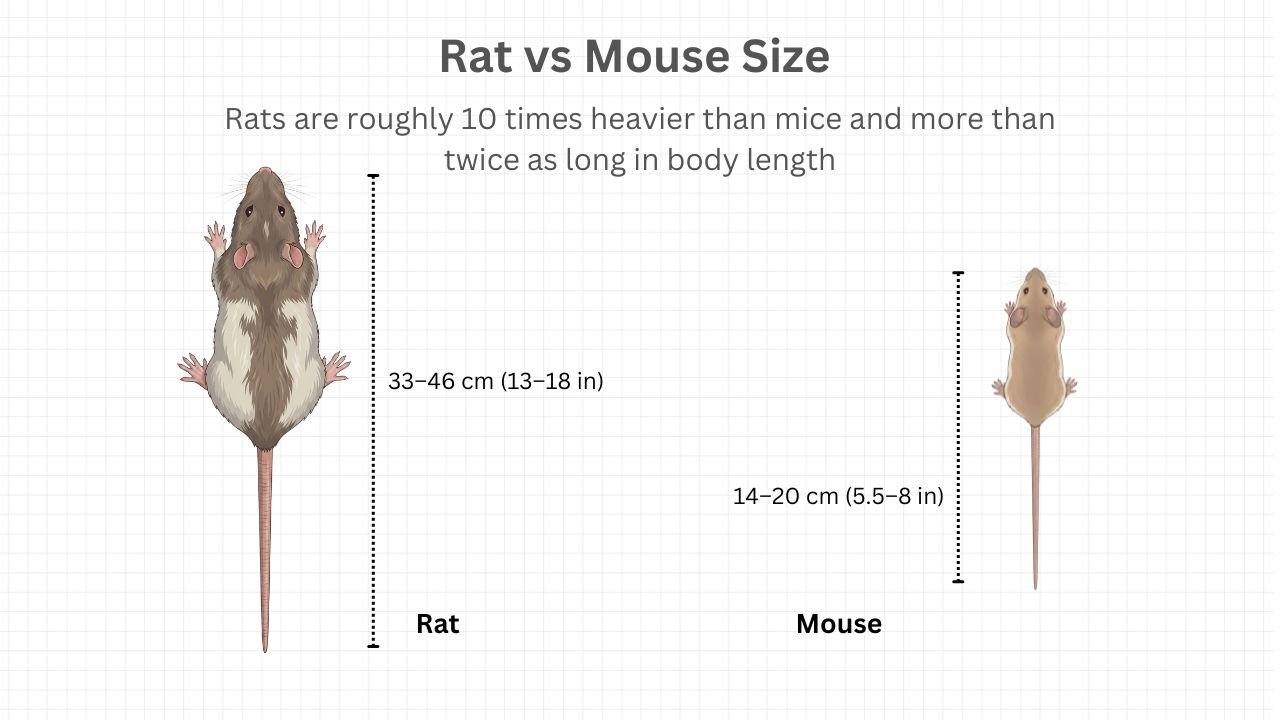
| Total Length (with tail) | 33–46 cm (13–18 in) | 14–20 cm (5.5–8 in) |
| Weight | 150–500 g (5–18 oz) | 12–30 g (0.4–1 oz) |
| Ear Size | Small relative to head | Large relative to head |
| Head Shape | Blunt, heavy, wide | Triangular, small, pointed |
| Eye Size | Small relative to head | Large relative to head |
The numbers tell a striking story. A full-grown Norway rat — the most common rat species worldwide — is roughly 10 times heavier than a house mouse and more than twice as long in body length. When you include the tail, a large rat can measure nearly 18 inches from nose to tail tip — compared to a mouse’s modest 8 inches. These are not subtle differences; once you know what to look for, a rat and a mouse side by side look like completely different animals.
The Most Common Species: Who Are We Comparing?
To make the comparison meaningful, it helps to know the specific species most commonly encountered:
The Norway Rat (Rattus norvegicus)
Also called the brown rat, common rat, sewer rat, or street rat. This is the most widespread rat species on Earth — found on every continent except Antarctica. Despite the name, it originated in Central Asia, not Norway. It is a burrowing species that prefers ground level — sewers, basements, and beneath structures. The Norway rat is the species most people encounter when they have a rat problem.
The Roof Rat (Rattus rattus)
Also called the black rat or ship rat. Smaller and more slender than the Norway rat — body length of 15–20 cm and weight of 75–230 g. Roof rats are agile climbers and prefer elevated spaces — attics, rafters, and trees. They are the rat species historically associated with spreading plague via fleas. In warm climates, roof rats are often more common than Norway rats.
The House Mouse (Mus musculus)
The most common mouse species globally — small, adaptable, and found wherever humans live. House mice are prolific breeders, capable of producing 5–10 litters of 5–6 pups per year — making an infestation grow quickly if not addressed. They are curious by nature, which makes them easier to trap than the more cautious rat.
Body Size: A Detailed Look
Head & Face
One of the clearest visual identifiers in the rat vs mouse size comparison is the head and face shape.
A rat’s head is large, heavy, and blunt — with a wide, rounded snout, small eyes relative to its head size, and small ears that would look proportional on a much smaller animal. The overall impression is of a stocky, serious-looking animal.
A mouse’s head is comparatively dainty — a small, triangular, pointed snout, large round eyes that take up a noticeable portion of the face, and large ears that are almost cartoonishly big relative to the tiny head. If the rat looks like a bruiser, the mouse looks almost cute.
This head shape difference alone is usually enough to tell the two apart instantly, even from a distance.
Body Shape
Rats have a robust, muscular, heavy body with thick haunches and a barrel-like torso. They move with a deliberate, heavy gait — especially large Norway rats, which can look almost cat-sized at first glance in low light.
Mice have a slender, delicate, lightweight body — almost fragile in appearance. They move with quick, darting movements and can squeeze through gaps as small as 6mm (¼ inch) — roughly the width of a pencil. A rat needs a gap of at least 20mm (¾ inch) to squeeze through.
The Tail
Both animals have long, scaly, mostly hairless tails — but they differ in proportion and texture.
| Tail Feature | Rat 🐀 | Mouse 🐭 |
|---|---|---|
| Length vs Body | Shorter than body length | Equal to or longer than body |
| Thickness | Thick at base, tapers | Uniformly thin |
| Texture | Scaly, segmented | Thin, lightly haired |
| Appearance | Heavy, rope-like | Delicate, thread-like |
A mouse’s tail is proportionally longer relative to its body than a rat’s — often equaling or exceeding the body length. A rat’s tail is thick and heavy-looking at the base, tapering toward the tip.
Feet & Hands
Rats have noticeably large, thick feet relative to their body — built for burrowing and supporting their heavier body weight. Their hind feet in particular are wide and powerful.
Mouse feet are tiny and delicate — almost impossibly small for the distances mice can cover. Despite their size, mice are excellent climbers, jumpers, and swimmers — able to jump vertically up to 30 cm (12 inches) from a standing position.
Rat vs Mouse Size: Droppings Comparison
One of the most reliable ways to identify which rodent is present — especially when you haven’t seen the animal itself — is by the size and shape of droppings. This is a key identification tool used by pest control professionals worldwide.
| Feature | Rat Droppings 🐀 | Mouse Droppings 🐭 |
|---|---|---|
| Length | 12–20 mm (½–¾ inch) | 3–6 mm (⅛–¼ inch) |
| Shape | Capsule-shaped, blunt ends | Rod-shaped, pointed ends |
| Width | ~6 mm | ~2 mm |
| Daily output | 40–50 droppings | 50–80 droppings |
| Color (fresh) | Dark brown/black | Dark brown/black |
Rat droppings are roughly 3–4 times larger than mouse droppings — about the size of a large olive pit vs a grain of rice. If you find small, rice-grain-sized droppings with pointed ends, you have mice. If you find large, capsule-shaped droppings the size of a raisin, you have rats. This single identification method is consistently reliable.
Pup (Baby) Size Comparison
Even rat and mouse babies differ significantly in size — though young rats are sometimes mistaken for adult mice, which causes considerable confusion.
| Stage | Rat Pup 🐀 | Mouse Pup 🐭 |
|---|---|---|
| Birth weight | ~5–7 g | ~1–1.5 g |
| Eyes open | ~14–17 days | ~12–14 days |
| Weaned | ~21 days | ~21 days |
| Adult size reached | ~3–4 months | ~6–8 weeks |
| Litters per year | 4–6 | 5–10 |
| Pups per litter | 6–12 | 5–8 |
A key point of confusion: juvenile Norway rats are sometimes mistaken for adult mice. The way to tell them apart is by the proportions — a young rat will have noticeably large feet and a large head relative to its body size, while an adult mouse has dainty, proportional features. A young rat’s feet will look almost oversized — like a puppy that hasn’t grown into its paws yet.
Behavior & Intelligence: Size Reflects Capability
The size difference between rats and mice corresponds directly to a significant difference in intelligence, caution, and behavior — which matters enormously if you’re trying to manage an infestation.
Rat Behavior
- Highly neophobic — rats are deeply suspicious of new objects in their environment, including traps and bait stations. It can take days or weeks for rats to approach a new trap
- Social and hierarchical — rats live in organized colonies with dominant individuals controlling food and territory
- Excellent problem solvers — rats have been trained to navigate complex mazes, drive tiny cars, and detect landmines and tuberculosis with remarkable accuracy
- Cautious foragers — rats will test small amounts of new food before committing to it, making poison baiting more difficult
- Burrowers — Norway rats create extensive burrow systems with multiple entrances and emergency exits
Mouse Behavior
- Curious by nature — mice will actively explore new objects in their environment, making them significantly easier to trap than rats
- Opportunistic feeders — mice nibble on dozens of different food sources per day rather than consuming large meals
- Less social than rats — house mice live in smaller family groups with a dominant male and several females
- Prolific territory markers — mice urinate constantly as they move, leaving scent trails that attract other mice and are detectable under UV light
What Does Each Look Like in Your Home?
Knowing the size difference helps you interpret the evidence you find:
| Evidence | Likely Rat 🐀 | Likely Mouse 🐭 |
|---|---|---|
| Droppings | Large, olive-pit sized | Tiny, rice-grain sized |
| Entry holes | 20mm+ diameter | 6mm+ diameter (dime-sized) |
| Gnaw marks | Large, rough, deep | Small, clean, shallow |
| Grease marks | Wide, dark smears along walls | Faint, thin smear marks |
| Footprints | Large, wide, heavy impression | Tiny, light impression |
| Sounds | Heavy scratching, thumping | Light scratching, scurrying |
| Nests | Large, shredded material in low areas | Small, compact nests in hidden cavities |
Rat vs Mouse Size in Different Species
Not all rats and mice are the same size. Here’s a broader species comparison:
| Species | Body Length | Weight | Notes |
|---|---|---|---|
| House Mouse | 7–10 cm | 12–30 g | Most common worldwide |
| Deer Mouse | 7–10 cm | 15–35 g | Common in North America |
| Roof Rat | 15–20 cm | 75–230 g | Slender; excellent climber |
| Norway Rat | 18–25 cm | 150–500 g | Most common rat; ground dweller |
| Gambian Pouched Rat | 25–45 cm | 1–1.4 kg | Used to detect landmines; giant species |
| Capybara* | 100–130 cm | 35–65 kg | World’s largest rodent |
*The capybara — technically a rodent — puts the entire rat vs mouse size comparison in perspective. At up to 65 kg, it outweighs a Norway rat by more than 100 times.
Key Identification Summary: Rat vs Mouse at a Glance
| Feature | Rat 🐀 | Mouse 🐭 |
|---|---|---|
| Body size | Large, heavy, robust | Small, delicate, slender |
| Head | Blunt, wide, heavy | Triangular, pointed, small |
| Eyes | Small relative to head | Large relative to head |
| Ears | Small relative to head | Large relative to head |
| Tail | Thick, shorter than body | Thin, equal to or longer than body |
| Feet | Large, wide | Tiny, delicate |
| Droppings | 12–20 mm, blunt ends | 3–6 mm, pointed ends |
| Entry hole | 20mm+ | 6mm+ |
| Behavior | Cautious, neophobic | Curious, exploratory |
| Intelligence | Very high | Moderate |
| Breeding speed | Fast (4–6 litters/yr) | Very fast (5–10 litters/yr) |
Key Takeaways
- Rats are roughly 10 times heavier than mice and more than twice as long in body length
- The clearest visual differences are head shape (blunt vs triangular), ear size (small vs large), and overall bulk
- Droppings are the most reliable evidence — rat droppings are 3–4× larger than mouse droppings
- Young rats are sometimes mistaken for adult mice — look for oversized feet and head on the young rat
- Rats are far more cautious than mice, making them harder to trap and control
- Both species can squeeze through gaps much smaller than their body size — mice through 6mm, rats through 20mm
Conclusion
The rat vs mouse size comparison reveals two animals that share a superficial similarity but are genuinely quite different in scale, behavior, and impact. A rat is a substantially larger, more cautious, and more intelligent animal than a mouse — and identifying which one you’re dealing with is the essential first step in addressing any rodent problem effectively.
The next time you spot a rodent — or just the evidence of one — use the size clues in this guide: check the droppings, look at the entry holes, listen to the sounds, and look at the proportions. A large, blunt-headed, heavy-footed animal with olive-pit droppings is a rat. A tiny, big-eared, delicate animal leaving rice-grain droppings is a mouse. Once you know the difference, you’ll never confuse them again.