F250 vs F150 Size: How Big Is the Difference? (Complete 2026 Guide)
Introduction
The F250 vs F150 size question is one of the most searched truck comparisons in America — and for good reason. These two Ford pickups are the most popular trucks on the road, but they sit in completely different classes, serve different purposes, and differ meaningfully in physical dimensions, capability, and presence on the road.
If you’re trying to decide between an F150 and an F250 — or simply want to understand how they compare in size — this guide covers everything: physical dimensions, bed sizes, cab sizes, weight, towing, payload, and which truck makes sense for your lifestyle.
F250 vs F150 Size: Physical Dimensions at a Glance
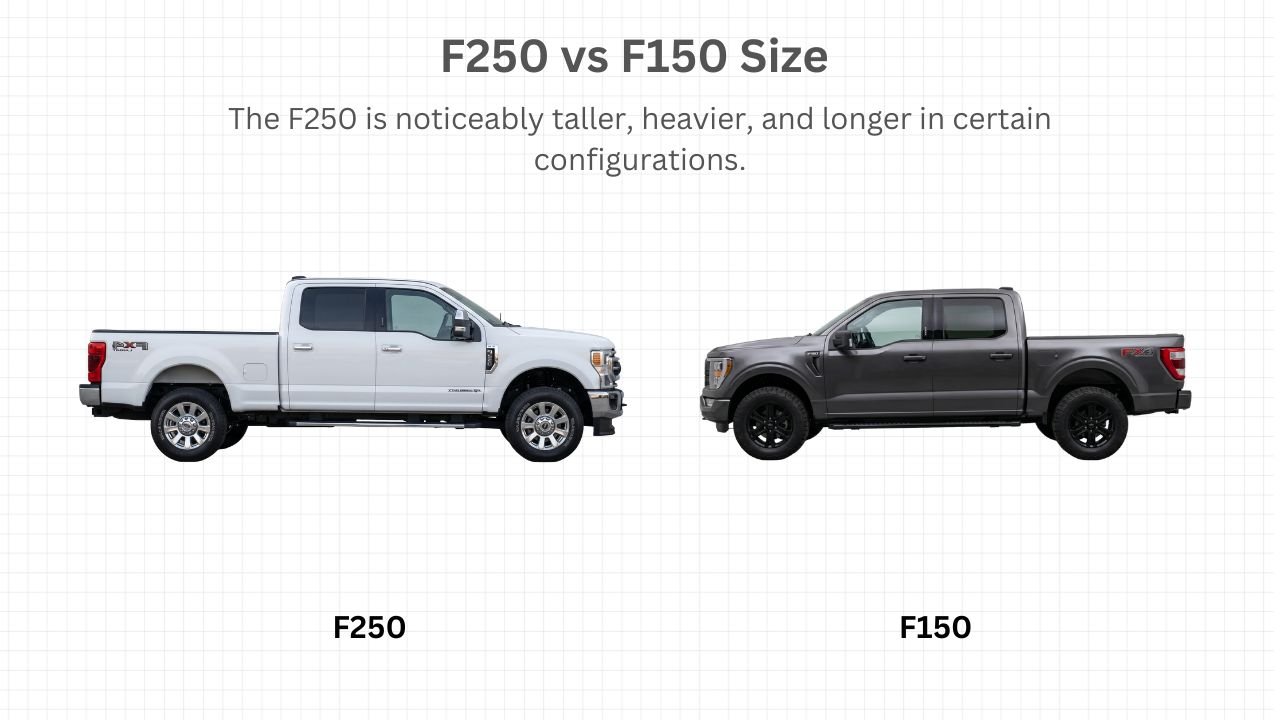
The dimensions of these two trucks vary based on trim level, but a popular F150 model measures 228.1 inches in length compared to 231.8 inches for the F250. The F150 and F250 are almost identical in terms of width, coming in at about 80 inches. The F150 stands 75 inches in height while the F250 is 78.9 inches high.
| Dimension | Ford F150 🔵 | Ford F250 Super Duty 🔴 |
|---|---|---|
| Length (SuperCrew) | ~228 inches (19 ft) | ~232 inches (19.3 ft) |
| Width (w/o mirrors) | ~80 inches (6.6 ft) | ~80 inches (6.6 ft) |
| Height | ~75 inches (6.25 ft) | ~79 inches (6.6 ft) |
| Wheelbase | 141.1–163.7 in | 141.8–176.8 in |
| Curb Weight | ~4,021–5,031 lbs | ~5,677–7,538 lbs |
| GVWR | Up to 7,850 lbs | Over 8,500 lbs |
| Bed Length Options | 5.5 ft, 6.5 ft, 8 ft | 6.75 ft, 8 ft |
The numbers reveal something important: these two trucks are closer in size than most people expect — but the F250 is noticeably taller, heavier, and longer in certain configurations. The width is nearly identical, which means both trucks take up roughly the same lane space and fit in standard parking spots (barely). The F250’s extra height and significantly heavier curb weight are the most immediately noticeable physical differences in real-world use.
Cab Size Comparison
The F150 offers a Regular Cab, SuperCab, and SuperCrew, while the F250 has a Regular Cab, SuperCab, and Crew Cab. Both trucks offer cab options with identical or similar max seating, legroom, and headroom in corresponding cab sizes.
Cab Size Comparison
The F150 offers a Regular Cab, SuperCab, and SuperCrew, while the F250 has a Regular Cab, SuperCab, and Crew Cab. Both trucks offer cab options with identical or similar max seating, legroom, and headroom in corresponding cab sizes.
| Cab Type | F150 | F250 |
|---|---|---|
| Regular Cab | ✅ Available | ✅ Available |
| Extended Cab (SuperCab) | ✅ Available | ✅ Available |
| Crew Cab / SuperCrew | ✅ Available | ✅ Available |
| Max Seating | 6 passengers | 6 passengers |
The interior dimensions of comparable cab configurations are essentially the same between the two trucks — if you’re sitting inside a SuperCrew F150 and a Crew Cab F250, the experience feels nearly identical from a passenger comfort perspective. The F150 and the F250 have similar interior and technology features — their differences have more to do with size, engine, and towing capability.
Bed Size Comparison
The bed sizes are where the two trucks begin to diverge meaningfully.
| Bed Option | F150 | F250 |
|---|---|---|
| Short bed (5.5 ft) | ✅ Available | ❌ Not available |
| Standard bed (6.5–6.75 ft) | ✅ 6.5 ft | ✅ 6.75 ft |
| Long bed (8 ft) | ✅ Available | ✅ Available |
The F150 offers three bed sizes including a short 5.5-foot bed, while the Super Duty F250 offers two. Both trucks offer an 8-foot long bed.
The F250 does not come with a 5.5-foot short bed — its smallest option is 6.75 feet. This reflects the F250’s work-truck DNA; it’s not designed for suburban commuters who want a short bed for parking convenience. The long bed (8 ft) on both trucks is the same length — but the F250’s bed is built with a heavier-duty liner, tougher sidewalls, and higher payload capacity.
Weight Difference: The Biggest Size Gap
This is where the F250 vs F150 size comparison becomes most dramatic — not in length or width, but in raw weight.
| Weight Metric | F150 | F250 |
|---|---|---|
| Curb Weight (lightest config) | ~4,021 lbs | ~5,677 lbs |
| Curb Weight (heaviest config) | ~5,031 lbs | ~7,538 lbs |
| GVWR | Up to ~7,850 lbs | Over 8,500 lbs |
| Weight difference | — | ~1,300–2,500 lbs heavier |
In their base configurations, the F150 is approximately 1,300 pounds lighter than the Super Duty F250. In heavier configurations — diesel engine, long bed, crew cab — the gap widens considerably. The F250 is a substantially heavier vehicle, which is why it requires a commercial driver’s license in some towing configurations and why fuel economy takes a significant hit compared to the F150.
The GVWR (Gross Vehicle Weight Rating) is also a key legal and practical distinction. The F250’s gross vehicle weight rating exceeds 8,500 pounds, while the F150’s GVWR is well below that. This threshold is important for commercial use, road regulations, and insurance classifications.
Engine Size & Power Comparison
The size difference between these two trucks extends to what’s under the hood.
| Engine | F150 | F250 |
|---|---|---|
| Base engine | 2.7L EcoBoost V6 (325 hp) | 6.2L V8 Gas (430 hp) |
| Top gas engine | 5.2L Supercharged V8 (720 hp — Raptor R) | 6.8L V8 Gas (430 hp) |
| Diesel option | ❌ None (2025) | ✅ 6.7L Power Stroke V8 Diesel |
| Max diesel torque | N/A | 1,200 lb-ft (high-output Power Stroke) |
| Hybrid option | ✅ 3.5L PowerBoost (430 hp) | ❌ None |
| Transmission | 10-speed automatic | 10-speed automatic |
If diesel power is more your speed, the Super Duty F250 has two Power Stroke engines that are bound to impress — the standard-output Power Stroke makes 1,050 pound-feet of torque, while the high-output version makes an astounding 1,200 pound-feet of torque.
The F250’s diesel torque figures are extraordinary — 1,200 lb-ft is among the highest torque outputs of any production pickup truck in the world. This is raw pulling power designed for fifth-wheel trailers, heavy equipment, and commercial hauling. Meanwhile, the F150 Raptor is available with a high-output supercharged V8 engine that makes 720 horsepower for all your off-road adventures — making the F150 the clear winner for performance enthusiasts who don’t need heavy towing.
Towing & Payload: Where Size Translates to Capability
The physical size difference between the F250 and F150 translates directly into dramatically different towing and payload capabilities.
| Capability | F150 | F250 |
|---|---|---|
| Max towing (conventional) | 13,500 lbs | 22,000 lbs |
| Max towing (gooseneck/5th wheel) | N/A | 23,000 lbs |
| Max payload | 2,440 lbs | 4,246 lbs |
Tow up to 13,500 pounds in the 2025 F150 or up to 22,000 pounds with the Super Duty F250. Maximum payload capability tops out at 2,440 pounds with the F150 and 4,246 pounds with the Super Duty F250.
The F250 can tow 63% more than the F150 at maximum rating, and haul 74% more payload in the bed. These aren’t small incremental improvements — they represent a completely different class of truck capability. The F250 is designed to pull horse trailers, heavy construction equipment, large fifth-wheel RVs, and commercial loads that the F150 simply cannot handle safely or legally.
Fuel Economy: The Size Tax
The F250’s larger size and heavier-duty drivetrain come at a direct fuel cost.
| Fuel Economy | F150 | F250 |
|---|---|---|
| Best MPG (hybrid) | 22 city / 24 hwy (PowerBoost) | Not available |
| Typical gas MPG | 18–23 mpg combined | 14–17 mpg combined (estimated) |
| Diesel MPG | N/A | ~18–20 mpg combined (estimated) |
| EPA testing | Fully EPA rated | Not EPA tested (over 8,500 lb GVWR) |
The F150 vs F250 MPG comparison is difficult to accurately depict due to the lack of EPA testing for F250 Super Duty models, but in general the F150 is more fuel efficient due to its smaller size, gas and hybrid engine options.
Unique to the F150 is the full hybrid 3.5L PowerBoost engine, which gets 22 MPG in the city and 24 MPG around town — making it one of the most fuel-efficient full-size trucks available. The F250 has no hybrid option, and its diesel engine — while more efficient than its gas counterpart — still falls short of F150 fuel economy in everyday driving.
Physical Presence: How They Feel on the Road
Numbers tell part of the story — but how these trucks actually feel in daily use is just as important.
The F150 feels like a large but manageable truck. It fits in most parking garages (check height), navigates urban environments reasonably well, and doesn’t attract too much attention in suburban settings. It’s big but not intimidating.
The F250 Super Duty is a different experience entirely. Its impressive towing and hauling capabilities and size make it challenging to drive around town or park anywhere. The F250 sits noticeably higher, feels substantially heavier through corners, and requires more confident driving in tight spaces. Parallel parking a long-bed F250 SuperCrew in a city is a genuine challenge. Gas stations require careful approach — the truck’s height combined with a trailer can make standard canopy clearances tight.
For anyone who doesn’t genuinely need the F250’s extra capability, these daily driving compromises are real and ongoing.
Starting Price Comparison
| Truck | Starting MSRP (2025) |
|---|---|
| Ford F150 (base XL) | ~$36,770 |
| Ford F250 Super Duty (base XL) | ~$44,970 |
| Price difference | ~$8,200 more for F250 |
Starting at an affordable price point of $36,770 MSRP, the Ford F150 delivers exceptional value, combining capability, versatility, and affordability. With a starting price from $44,970 MSRP, you can find the Ford F250 on our lot in several variations.
The F250 carries a premium of roughly $8,000 over the base F150 — a gap that widens significantly when you add popular options like the diesel engine, which can add $10,000+ to the sticker price. A fully loaded F250 with the high-output diesel easily pushes past $90,000.
Head-to-Head Size Summary
| Category | F150 🔵 | F250 🔴 |
|---|---|---|
| Length | ~228 inches | ~232 inches |
| Width | ~80 inches | ~80 inches |
| Height | ~75 inches | ~79 inches |
| Curb weight | 4,021–5,031 lbs | 5,677–7,538 lbs |
| Bed sizes | 5.5, 6.5, 8 ft | 6.75, 8 ft |
| Max towing | 13,500 lbs | 22,000 lbs |
| Max payload | 2,440 lbs | 4,246 lbs |
| Fuel economy | ✅ Better | ❌ Lower |
| Parking / daily drive | ✅ Easier | More challenging |
| Price | ✅ Lower | Higher |
| Diesel option | ❌ No | ✅ Yes |
| Hybrid option | ✅ Yes | ❌ No |
Which Truck Should You Choose?
The F150 is the quintessential light-duty truck, hugely popular for its versatility and efficiency — an ideal choice for everyday drivers, outdoor enthusiasts, small business owners, and weekend warriors. The F250 is a heavyweight powerhouse designed for some of the toughest tasks — a go-to for those who require substantial towing and hauling capabilities, such as construction professionals, ranchers, and serious trailer towers.
Choose the F150 if you:
- Use the truck primarily for daily driving and commuting
- Tow a boat, camper, or trailer under 13,500 lbs
- Want better fuel economy — especially the hybrid option
- Need to navigate parking garages and urban environments
- Are price-conscious or don’t need heavy-duty capability
- Want the most tech and driver-assistance features standard
Choose the F250 if you:
- Regularly tow over 13,500 lbs — fifth wheels, heavy trailers, equipment
- Need maximum payload in the bed for commercial or farm work
- Want diesel engine power and torque
- Work in construction, ranching, landscaping, or commercial hauling
- Need a truck that can handle demanding conditions day after day
- Require gooseneck or fifth-wheel towing capability
Key Takeaways: F250 vs F150 Size
- The F250 is longer, taller, and significantly heavier than the F150
- Width is nearly identical — both measure around 80 inches wide
- The F250 weighs roughly 1,300–2,500 lbs more depending on configuration
- The F250’s bed starts at 6.75 ft — the F150 offers a shorter 5.5 ft option
- The F250 tows 63% more and hauls 74% more payload
- The F150 is significantly more fuel efficient and easier in daily driving
- The F250 starts about $8,200 more than an equivalent F150
Conclusion
The F250 vs F150 size comparison reveals two trucks that look similar on the surface but diverge significantly in physical weight, capability, and purpose. The F150 is bigger than it has ever been — a full-size truck in every meaningful sense — yet the F250 Super Duty takes everything up another full level: heavier frame, taller stance, more payload, far more towing power, and a diesel engine option that produces torque figures previously reserved for commercial vehicles.
If you genuinely need that capability — and many buyers do — the F250’s size premium is absolutely worth it. If you don’t, the F150 is the smarter, more efficient, more livable choice that still handles the overwhelming majority of real-world truck tasks with ease.