Tahoe vs Suburban Size: How Big Is the Difference? (2026 Complete Guide)
Introduction
The Tahoe vs Suburban size debate is one of the most common questions among full-size SUV shoppers — and for good reason. These two Chevrolet icons look remarkably similar on the surface, share the same engines, the same trim levels, and nearly identical features. Yet one is noticeably larger than the other, and that size difference has real, meaningful consequences for your everyday driving experience, your family’s comfort, and your ability to haul gear on long road trips.
So how big is the difference, really? This complete guide breaks down every dimension — exterior length, wheelbase, height, cargo space, interior room, towing, and more — so you can make a fully informed decision between these two family SUV giants.
Tahoe vs Suburban Size: Core Dimensions at a Glance
The Chevy Tahoe is 211.3 inches long, 81 inches wide, and between 75.8 and 76.8 inches tall. It has a wheelbase of 120.9 inches. The Suburban measures 226.3 inches long with a wheelbase of 134.1 inches. The Suburban is 81 inches wide and up to 76.6 inches tall.
| Dimension | Chevy Tahoe 🔵 | Chevy Suburban 🔴 |
|---|---|---|
| Overall Length | 211.3 inches (17.6 ft) | 226.3 inches (18.9 ft) |
| Width (without mirrors) | 81 inches (6.75 ft) | 81 inches (6.75 ft) |
| Height | 75.8–76.8 inches | 76.6 inches |
| Wheelbase | 120.9 inches | 134.1 inches |
| Ground Clearance | ~8–9 inches | ~8–9 inches |
| Turning Radius | 37.8 ft (curb to curb) | 41.5 ft (curb to curb) |
| Curb Weight | ~5,355–5,720 lbs | ~5,745–6,095 lbs |
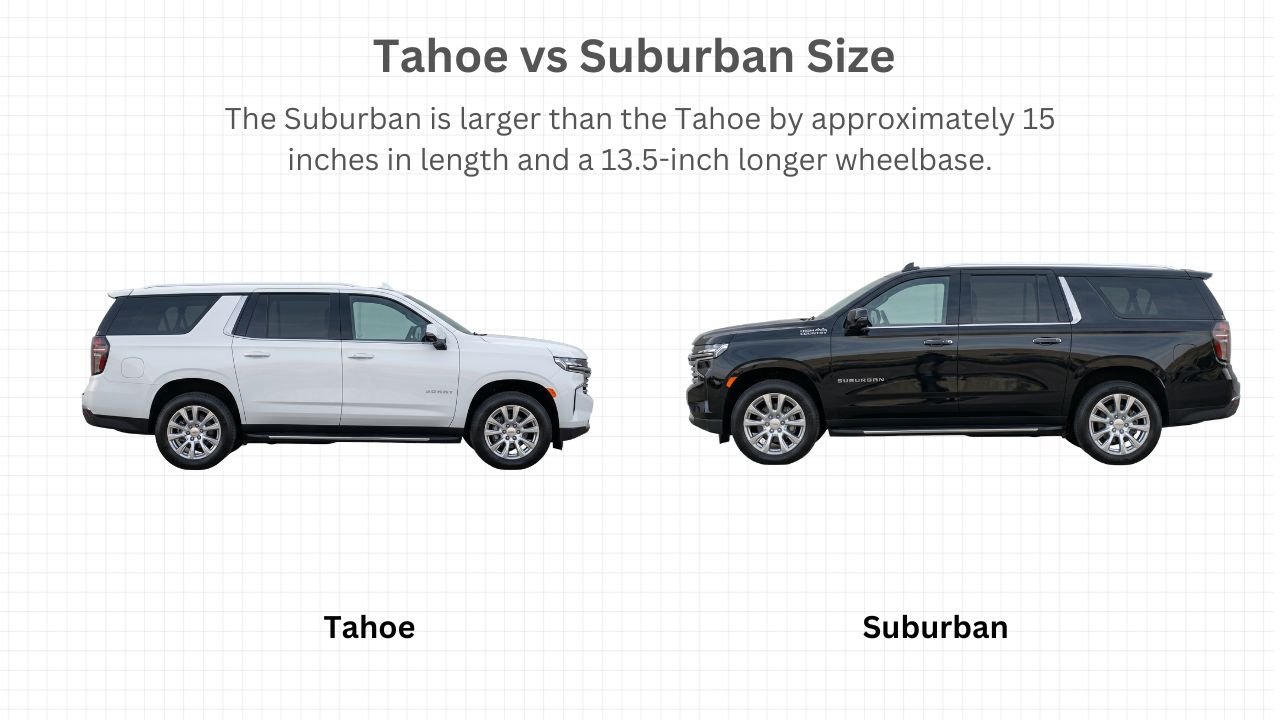
The headline number: the Suburban is larger than the Tahoe by approximately 15 inches in length and a 13.5-inch longer wheelbase. That single 15-inch difference in length is what creates all the meaningful interior and cargo advantages the Suburban holds — and all the maneuverability advantages the Tahoe enjoys.
Width and height are essentially the same between the two vehicles. If you park them side by side, they look like the same truck from the front — it’s only when you walk around to the rear that the Suburban’s extra length becomes obvious.
The 15-Inch Length Difference: What Does It Actually Mean?
Fifteen inches of extra length sounds like a technical spec — but in the real world, it changes the Suburban’s character significantly compared to the Tahoe. The longer wheelbase is especially noticeable at the rear three-quarter view, with the Suburban having a more extended rear section.
That extended rear section is where all of the Suburban’s advantages live — more third-row legroom, dramatically more cargo space behind the third row, and an overall sense of a much larger vehicle once you’re inside. The Tahoe uses those same 15 inches of removed length to become a more nimble, easier-to-park, city-friendlier vehicle without sacrificing the front two rows of passenger space.
The Tahoe offers a tighter turning radius of 37.8 feet compared to the Suburban’s 41.5 feet — a difference that becomes very real when you’re navigating a crowded parking lot, making a tight U-turn, or threading through a busy urban street. In everyday driving, the Tahoe simply feels more manageable.
Cargo Space: The Biggest Real-World Size Difference
This is where the Tahoe vs Suburban size gap becomes most tangible — especially for families who actually use their cargo area.
| Cargo Space | Chevy Tahoe 🔵 | Chevy Suburban 🔴 |
|---|---|---|
| Behind 3rd row | 25.5 cu ft | 41.5 cu ft |
| Behind 2nd row | ~72.6 cu ft | ~93.8 cu ft |
| Maximum (all rows folded) | 122.9 cu ft | 144.7 cu ft |
| Difference (max cargo) | — | +21.8 cu ft more |
Behind the third row, the Suburban has 41.5 cubic feet of cargo space. In comparison, the Tahoe only has 25.5 cubic feet of cargo space. In the Suburban, folding the rows gives you a max of 144.7 cubic feet of cargo space, while the Tahoe maxes out at 122.9 cubic feet.
To put 25.5 vs 41.5 cubic feet in perspective: that difference behind the third row is the equivalent of adding roughly two large checked airline suitcases worth of space. For a family of six loading up for a ski trip, a beach vacation, or a cross-country road trip, the Suburban’s rear cargo area is genuinely transformative. The Chevy Suburban boasts more than 20 cubic feet of extra cargo space than the Tahoe interior, giving you more flexibility for luggage and sporting gear.
With the Tahoe, families frequently find themselves forced to use a roof rack or cargo carrier for longer trips. With the Suburban, that extra space eliminates the problem entirely for most family configurations.
Interior Size: Passenger Space Comparison
Both the Tahoe and Suburban seat up to 8 passengers across three rows — but the experience in each row is not identical between the two vehicles.
| Interior Dimension | Chevy Tahoe 🔵 | Chevy Suburban 🔴 |
|---|---|---|
| Seating capacity | Up to 8 | Up to 8 |
| 1st row headroom | ~43 inches | ~43 inches |
| 2nd row legroom | ~39.6 inches | ~41.2 inches |
| 3rd row legroom | ~33.7 inches | ~34.9 inches |
| 3rd row headroom | ~34.6 inches | ~35.2 inches |
The first and second rows are nearly identical between the two vehicles — sitting in the front seats of a Tahoe and Suburban feels virtually the same. The meaningful difference shows up in the second and third rows, where the Suburban’s longer wheelbase stretches out additional legroom that adult passengers genuinely notice on longer drives.
The main difference between the Tahoe and Suburban is the interior seating and cargo space. While both offer room for up to eight passengers, the Chevy Suburban interior adds extra room to the third row, ensuring everyone has room to stretch out and relax.
The Tahoe’s third row is functional for children or shorter adults on shorter trips. The Suburban’s third row is genuinely comfortable for adults — a meaningful distinction for large families who regularly seat three rows of passengers. If your third row regularly carries adult passengers on long drives, the Suburban is the only sensible choice.
Exterior Size: How They Look and Feel on the Road
Both the Tahoe and Suburban share the same front fascia, grille design, headlights, hood, and front doors — from the driver’s seat, the view forward is identical. The Suburban’s extra length is entirely behind the B-pillar, stretching the rear passenger compartment and cargo area rearward.
The size of the Suburban lends itself better to families looking for every last inch of space, though it may be less comfortable navigating narrow downtown streets or crowded parking lots.
From a parking perspective, the Suburban’s extra 15 inches means it will overhang standard parking spaces in many garages and lots. Underground parking garages — particularly older ones — can be a challenge for the Suburban’s length. The Tahoe, while still a large vehicle, fits more comfortably in the same spaces.
Wheelbase Difference: Why It Matters So Much
The wheelbase — the distance between the front and rear axles — is the single number that explains everything about why the Suburban is larger and more comfortable than the Tahoe.
The Chevrolet Tahoe features a wheelbase length of around 120.9 inches while the longer Chevrolet Suburban has a wheelbase length of 134.1 inches.
That 13.2-inch wheelbase advantage does three specific things for the Suburban:
1. More second and third row legroom — the extra wheelbase distance pushes the second and third row seats further apart, giving passengers genuine breathing room.
2. More cargo space behind row three — the longer rear overhang behind the last row creates the Suburban’s dramatically larger cargo floor.
3. Smoother ride on highways — longer wheelbase vehicles generally track more stably at highway speeds and absorb road imperfections over a longer distance, resulting in a slightly smoother ride feel on long trips.
The tradeoff is the larger turning radius and reduced maneuverability in tight spaces.
Engine & Powertrain: Same Under the Hood
Despite their size difference, both the Tahoe and Suburban come with the same three available engine options: a 5.3-liter EcoTec3 V8 that produces up to 355 hp and 383 pound-feet of torque, a 6.2-liter V8 that produces up to 420 hp and 460 pound-feet of torque, and a 3.0-liter Duramax Turbo Diesel engine available in all models.
| Engine | Output | Available In |
|---|---|---|
| 5.3L EcoTec3 V8 | 355 hp / 383 lb-ft torque | Both (standard) |
| 6.2L EcoTec3 V8 | 420 hp / 460 lb-ft torque | Both (Premier/High Country) |
| 3.0L Duramax Diesel | ~277 hp / 460 lb-ft torque | Both (all trims) |
Having identical powertrains is one of the most practical aspects of this comparison — you’re not giving up any engine performance by choosing the Suburban, despite it being a larger, heavier vehicle.
Towing Capacity: Tahoe Edges Ahead
Despite the Suburban being the larger vehicle, the Tahoe actually wins on maximum towing capacity — and the reason is simple physics.
| Towing Spec | Chevy Tahoe 🔵 | Chevy Suburban 🔴 |
|---|---|---|
| Max towing capacity | 8,400 lbs | 8,200–8,300 lbs |
| Standard towing (5.3L V8) | ~7,900 lbs | ~7,800 lbs |
The Suburban, due to its heavier build, has a slightly lower maximum towing capacity, topping out at 8,200 pounds — just shy of what the Tahoe can manage. The Tahoe slightly edges out the Suburban in towing capacity, with a max tow rating of 8,400 pounds compared to the Suburban’s 8,300 pounds. This is marginal, as it’s the Tahoe’s slightly lower curb weight that results in better towing efficiency.
The difference is minimal — roughly 100–200 lbs — and won’t matter for the vast majority of towing situations. Both vehicles comfortably handle boats, campers, and trailers well within the capability range of most recreational users.
Fuel Economy: Nearly Equal, Tahoe Slightly Better
With identical engine and transmission options, the Tahoe and Suburban offer nearly the same EPA-estimated fuel economy across configurations. The Tahoe earns up to an EPA-estimated 15/20/17 MPG (City/Highway/Combined) with its standard 5.3-liter V8.
| Fuel Economy | Chevy Tahoe 🔵 | Chevy Suburban 🔴 |
|---|---|---|
| Gas V8 (5.3L) | 15 city / 20 hwy | 15 city / 19 hwy |
| Diesel (3.0L) | 22 city / 26 hwy | 21 city / 26 hwy |
| Fuel tank size | 24 gallons | 28 gallons |
| Max highway range | ~624 miles | ~728 miles |
The Tahoe gets marginally better city fuel economy due to its lighter weight — but the Suburban’s larger 28-gallon fuel tank gives it a significantly longer highway range. The Suburban’s larger fuel tank gives it the edge for longer drives, delivering an EPA-estimated maximum highway range of 728 miles compared to the Tahoe’s 624 miles. For road trip families, the Suburban’s 104-mile extra range means fewer fuel stops on long drives.
Trim Levels & Pricing
The Chevy Tahoe and Suburban are available in the same six trim levels, ranging from the base LS to the top High Country. The Tahoe is slightly cheaper with a starting MSRP of around $62,995 vs. the Suburban’s $65,995 for the base models.
| Trim Level | Tahoe Starting Price | Suburban Starting Price |
|---|---|---|
| LS (base) | ~$62,995 | ~$65,995 |
| LT | ~$68,000 | ~$71,000 |
| RST | ~$71,000 | ~$74,000 |
| Z71 | ~$73,000 | ~$76,000 |
| Premier | ~$79,000 | ~$82,000 |
| High Country | ~$91,000 | ~$94,000 |
The Suburban commands approximately $3,000 more than an equivalent Tahoe trim across the board — a relatively modest premium considering the significantly larger footprint and cargo space you gain. For many buyers, the extra $3,000 for a Suburban over an equivalent Tahoe is one of the best value propositions in the full-size SUV segment.
Technology & Features: Virtually Identical
One of the most important practical points of the Tahoe vs Suburban comparison: both vehicles are loaded with the same technology at every equivalent trim level.
Both the Tahoe and Suburban include:
- 17.7-inch touchscreen (standard on all 2025 trims) with Google Built-In
- Wireless Apple CarPlay and Android Auto
- Amazon Alexa and Google Assistant integration
- 360-degree camera system
- Blind Spot Information System (BLIS) with trailer coverage
- Adaptive cruise control and automatic emergency braking
- Available rear-seat entertainment screens
- Available Super Cruise hands-free driving (on select trims)
- Available 4WD with Auto, 2-Hi, 4-Hi, and 4-Lo modes
Safety features are abundant across all models, including blind spot monitoring, adaptive cruise control, and emergency braking. You are not giving up any technology or safety features by choosing either vehicle — the decision is purely about size, cargo space, and maneuverability preference.
Head-to-Head Size Summary
| Category | Tahoe 🔵 | Suburban 🔴 | Winner |
|---|---|---|---|
| Overall length | 211.3 inches | 226.3 inches | 🔴 Suburban |
| Width | 81 inches | 81 inches | Tie |
| Height | ~76 inches | ~76.6 inches | Tie |
| Wheelbase | 120.9 inches | 134.1 inches | 🔴 Suburban |
| Cargo (behind row 3) | 25.5 cu ft | 41.5 cu ft | 🔴 Suburban (+63%) |
| Max cargo space | 122.9 cu ft | 144.7 cu ft | 🔴 Suburban (+18%) |
| 3rd row legroom | 33.7 inches | 34.9 inches | 🔴 Suburban |
| Towing capacity | 8,400 lbs | 8,200 lbs | 🔵 Tahoe |
| City fuel economy | Slightly better | Slightly lower | 🔵 Tahoe |
| Highway range | 624 miles | 728 miles | 🔴 Suburban |
| Turning radius | 37.8 ft | 41.5 ft | 🔵 Tahoe (tighter) |
| Starting price | ~$62,995 | ~$65,995 | 🔵 Tahoe |
| Maneuverability | ✅ Easier | More challenging | 🔵 Tahoe |
Which One Should You Choose?
Whether you prefer the Chevy Suburban or Tahoe depends on your priorities. If you’re looking for maximum interior space, the new Suburban is the better option.
Choose the Tahoe if you:
- Drive frequently in urban environments or tight parking situations
- Primarily carry 5–6 passengers, not a full 7–8 regularly
- Don’t need maximum cargo space on most trips
- Want slightly better fuel economy and towing efficiency
- Are more budget-conscious between the two
- Value a tighter turning radius and easier daily maneuverability
Choose the Suburban if you:
- Regularly carry 7–8 passengers including adults in the third row
- Need maximum cargo space — especially for road trips, sports gear, or family travel
- Take long highway drives and appreciate fewer fuel stops
- Have a large family that regularly uses all three rows
- Are willing to pay a modest $3,000 premium for significantly more space
- Primarily drive on highways and open roads rather than dense urban streets
Key Takeaways: Tahoe vs Suburban Size
- The Suburban is 15 inches longer and has a 13.2-inch longer wheelbase than the Tahoe
- Both are equally wide at 81 inches and nearly the same height
- The Suburban has 63% more cargo space behind the third row (41.5 vs 25.5 cu ft)
- The Suburban offers 21.8 more cubic feet of maximum total cargo space
- The Tahoe has a tighter turning radius (37.8 ft vs 41.5 ft) — easier to maneuver
- Both share identical engines, trim levels, and technology features
- The Suburban costs approximately $3,000 more at every equivalent trim level
- The Suburban’s larger fuel tank gives it a 104-mile longer highway range
Conclusion
The Tahoe vs Suburban size comparison comes down to one essential question: how much space do you actually need? The Suburban is the clear winner on interior room, cargo capacity, and highway range — 15 extra inches of length translating into a dramatically more practical vehicle for large families and heavy-use road trippers. The Tahoe wins on maneuverability, towing efficiency, city fuel economy, and price — making it the smarter choice for families who want full-size SUV capability without the full-size SUV footprint in their daily life.
Both are outstanding vehicles built on the same platform with the same engines and the same features. The right choice depends entirely on how many people you carry, how much stuff you haul, and how often you deal with tight parking situations. Get the size right, and either truck will serve your family brilliantly for years.