Kodiak Bear vs Polar Bear Size: The Ultimate Giant Showdown

When it comes to the world’s largest land carnivores, two apex predators dominate the conversation: the Kodiak bear and the polar bear. Both are massive, powerful, and command respect in their respective habitats. But which one is actually larger? The answer might surprise you—it’s closer than you think.
Quick Answer: Polar bears are typically 100-200 pounds heavier and 6-12 inches taller than Kodiak bears, though the largest individuals of both species can reach similar maximum sizes.
Size Comparison at a Glance
Let’s start with the raw numbers:
| Species | Average Weight (Male) | Average Height (Standing) | Average Length | Shoulder Height |
|---|---|---|---|---|
| Polar Bear | 900-1,600 lbs | 8-10 feet | 7.5-8.5 feet | 4-5 feet |
| Kodiak Bear | 800-1,400 lbs | 8-9 feet | 6.5-8 feet | 4-4.5 feet |
| Difference | +100-200 lbs heavier | +6-12 inches taller | +6-12 inches longer | +0-6 inches taller |
The takeaway: On average, polar bears edge out Kodiak bears in almost every dimension, but the overlap is significant.
Maximum Size: When Giants Meet
While averages tell one story, the record-holders tell another:
| Species | Largest Recorded Weight | Largest Recorded Length | Where Found |
|---|---|---|---|
| Polar Bear | 2,209 lbs | 11.1 feet | Alaska, 1960 |
| Kodiak Bear | 2,130 lbs | 10.5 feet | Kodiak Island, Alaska |
| Difference | ~80 lbs | ~7 inches | Both in Alaska |
The reality: At their absolute largest, these two species are nearly identical in size. The heaviest Kodiak bears can rival the heaviest polar bears.
Male vs Female: The Size Difference
Sexual dimorphism (size difference between males and females) is pronounced in both species:
Male Comparison
| Species | Weight Range | Standing Height | Length |
|---|---|---|---|
| Polar Bear (Male) | 900-1,600 lbs | 8-10 feet | 7.5-8.5 feet |
| Kodiak Bear (Male) | 800-1,400 lbs | 8-9 feet | 6.5-8 feet |
Female Comparison
| Species | Weight Range | Standing Height | Length |
|---|---|---|---|
| Polar Bear (Female) | 330-550 lbs | 6-8 feet | 5.5-7 feet |
| Kodiak Bear (Female) | 400-700 lbs | 6-7 feet | 5-6.5 feet |
Interesting note: Female Kodiak bears can actually outweigh female polar bears by 50-150 pounds, reversing the male trend.
Body Proportions: Built for Different Worlds
While overall size is similar, their body shapes reveal different evolutionary adaptations:
| Feature | Polar Bear | Kodiak Bear | Purpose |
|---|---|---|---|
| Neck | Longer, more elongated | Shorter, thicker | Swimming vs power |
| Head | Smaller, more streamlined | Larger, broader | Aquatic vs terrestrial |
| Legs | Longer, more slender | Shorter, stockier | Ice travel vs climbing |
| Paws | Larger (12 inches wide) | Smaller (9-10 inches) | Swimming & ice grip |
| Body Shape | Leaner, more cylindrical | Bulkier, more muscular | Swimming vs digging |
Detailed Measurements
| Body Part | Polar Bear | Kodiak Bear | Advantage |
|---|---|---|---|
| Paw Width | 12 inches | 9-10 inches | Polar bear (swimming) |
| Claw Length | 2-3 inches | 2-4 inches | Similar (fishing/hunting) |
| Skull Length | 15-18 inches | 16-19 inches | Kodiak bear |
| Bite Force | ~1,200 PSI | ~1,100 PSI | Polar bear (slightly) |
Weight Through the Seasons
Both species experience dramatic weight fluctuations:
Polar Bear Seasonal Weight
| Season | Weight (Male) | Change | Reason |
|---|---|---|---|
| Spring | 900-1,200 lbs | Baseline | Post-hibernation (females) |
| Summer | 1,000-1,400 lbs | +100-200 lbs | Active hunting season |
| Fall | 1,200-1,600 lbs | +300-400 lbs | Peak feeding (seal hunting) |
| Winter | 1,000-1,300 lbs | Variable | Hunting on sea ice |
Kodiak Bear Seasonal Weight
| Season | Weight (Male) | Change | Reason |
|---|---|---|---|
| Spring | 600-800 lbs | Low point | Just emerged from den |
| Summer | 900-1,200 lbs | +300-400 lbs | Salmon run begins |
| Fall | 1,200-1,400 lbs | +600-800 lbs | Peak hyperphagia |
| Winter | Hibernating | N/A | Not eating |
Key difference: Kodiak bears can gain up to 400 pounds in a single summer, while polar bears maintain more consistent weight year-round due to continuous hunting.
Size by Age: Growth Timeline
Both species take years to reach full size:
| Age | Polar Bear Male | Kodiak Bear Male | Development Stage |
|---|---|---|---|
| Birth | 1-2 lbs | 1 lb | Helpless cubs |
| 1 Year | 100-150 lbs | 80-120 lbs | With mother |
| 2 Years | 200-300 lbs | 150-250 lbs | Independence begins |
| 5 Years | 600-900 lbs | 500-800 lbs | Sexual maturity |
| 8-10 Years | 900-1,400 lbs | 800-1,200 lbs | Near full size |
| 15+ Years | 1,200-1,600 lbs | 1,000-1,400 lbs | Prime/maximum size |
Growth pattern: Both species continue growing throughout their lives, with the largest individuals typically being older males in their prime hunting years.
Habitat Influence on Size
Geography plays a surprising role in determining size:
Polar Bear Size by Region
| Region | Average Male Weight | Why Different |
|---|---|---|
| Beaufort Sea (Alaska) | 1,200-1,500 lbs | Abundant seals |
| Hudson Bay (Canada) | 900-1,100 lbs | Shorter hunting season |
| Svalbard (Norway) | 800-1,000 lbs | Limited prey access |
| Chukchi Sea | 1,100-1,400 lbs | Good ice conditions |
Kodiak Bear Size by Location
| Location | Average Male Weight | Food Source |
|---|---|---|
| Kodiak Island | 1,000-1,400 lbs | Salmon-rich streams |
| Afognak Island | 900-1,200 lbs | Moderate salmon runs |
| Shuyak Island | 800-1,100 lbs | Limited salmon access |
The pattern: Better food availability = larger bears in both species.
Comparative Strength and Power
Size isn’t everything—let’s look at raw power:
| Strength Metric | Polar Bear | Kodiak Bear | Winner |
|---|---|---|---|
| Bite Force | ~1,200 PSI | ~1,100 PSI | Polar bear |
| Swipe Force | ~25,000+ lbs | ~27,000+ lbs | Kodiak bear |
| Lifting Capacity | 1,000+ lbs | 1,200+ lbs | Kodiak bear |
| Swimming Speed | 6 mph (sustained) | 5 mph (short distance) | Polar bear |
| Running Speed | 25 mph | 30-35 mph | Kodiak bear |
| Climbing Ability | Poor (rarely climb) | Excellent | Kodiak bear |
How They Compare to Other Bears
For context, here’s how these giants stack up against other bear species:
| Bear Species | Average Male Weight | Standing Height | Geographic Range |
|---|---|---|---|
| Polar Bear | 900-1,600 lbs | 8-10 feet | Arctic Circle |
| Kodiak Bear | 800-1,400 lbs | 8-9 feet | Kodiak Archipelago |
| Grizzly Bear | 400-800 lbs | 6.5-7 feet | North America |
| Siberian Brown Bear | 600-1,000 lbs | 7-8 feet | Russia |
| Black Bear | 200-600 lbs | 5-6 feet | North America |
| Sun Bear | 60-150 lbs | 4-5 feet | Southeast Asia |
The dominance: Kodiak and polar bears are in a league of their own, weighing 2-3 times more than most other bear species.
Diet and Its Impact on Size
What they eat directly influences how big they get:
Polar Bear Diet
| Food Source | % of Diet | Caloric Value | Availability |
|---|---|---|---|
| Ringed Seals | 60-70% | 50,000+ calories each | High (spring/summer) |
| Bearded Seals | 15-20% | 100,000+ calories each | Moderate |
| Walrus | 5-10% | Variable (opportunistic) | Low |
| Whale Carcasses | 5-10% | Extremely high | Rare |
Total annual intake: 150,000-200,000 calories needed to maintain size
Kodiak Bear Diet
| Food Source | % of Diet | Season | Caloric Impact |
|---|---|---|---|
| Salmon | 30-40% | Summer/Fall | 4,500 calories per fish |
| Berries | 20-25% | Late Summer | Moderate |
| Vegetation | 25-30% | Spring/Summer | Low |
| Carrion | 5-10% | Year-round | High |
| Clams/Mussels | 5-10% | Spring/Summer | Moderate |
Total annual intake: 100,000-150,000 calories needed before hibernation
The difference: Polar bears need more calories year-round because they don’t hibernate and must maintain body heat in extreme cold.
Size and Survival: Does Bigger Mean Better?
Surprisingly, extreme size has trade-offs:
Advantages of Large Size
| Benefit | Polar Bear | Kodiak Bear |
|---|---|---|
| Hunting Success | Better seal ambush | Dominance at fishing spots |
| Territory Control | Larger range defended | Prime salmon streams secured |
| Mate Selection | More breeding opportunities | Female preference |
| Fat Storage | Survive longer food gaps | Survive winter hibernation |
| Predator Defense | No natural predators | No natural predators |
Disadvantages of Large Size
| Challenge | Polar Bear | Kodiak Bear |
|---|---|---|
| Food Requirements | Must hunt constantly | Need massive fall feeding |
| Climate Change Impact | Harder to sustain on less ice | Less affected |
| Energy Expenditure | Higher metabolic cost | Higher hibernation needs |
| Heat Stress | Overheating risk increasing | Summer heat stress |
Who Would Win in a Fight?
The hypothetical question everyone asks. Here’s the realistic breakdown:
| Factor | Polar Bear Advantage | Kodiak Bear Advantage |
|---|---|---|
| Size | Slightly larger on average | Bulkier muscle mass |
| Weapons | Longer reach, bigger paws | Stronger swipe force |
| Experience | Apex predator, hunts large prey | Dominance battles common |
| Aggression | Naturally more aggressive | Defensive but fierce |
| Endurance | Better stamina | More explosive power |
The verdict: In the extremely unlikely event these two met, the polar bear’s slight size advantage and more predatory nature might give it an edge, but the outcome would depend on the individual bears. Both are perfectly adapted apex predators for their environments.
Climate Change: Impact on Size
Global warming is affecting both species differently:
Polar Bear Size Trends
| Impact | Trend | Projection |
|---|---|---|
| Average Weight | Declining in some populations | -10-15% by 2050 (some regions) |
| Body Condition | Worsening | Poor in ice-limited areas |
| Cub Survival | Decreasing | Smaller mothers = smaller cubs |
Kodiak Bear Size Trends
| Impact | Trend | Projection |
|---|---|---|
| Average Weight | Stable to increasing | Minimal change expected |
| Food Availability | Variable salmon runs | Depends on ocean temperatures |
| Habitat Quality | Relatively stable | Less direct impact |
The concern: Polar bears may lose their size advantage as sea ice declines, while Kodiak bears remain relatively stable.
Measuring Methods: How We Know
How do scientists actually measure these giants?
| Method | Accuracy | When Used | Limitations |
|---|---|---|---|
| Tranquilizer & Scale | Very high | Research captures | Dangerous, expensive |
| Aerial Photography | Moderate | Population surveys | Size estimates only |
| Track Measurements | Low to moderate | Field observation | Indirect measurement |
| Skull Measurements | Very high | Harvested bears | Only dead specimens |
| Visual Estimation | Low | Sightings | Highly variable |
Quick Comparison Summary
Polar Bear Wins:
✅ Average weight (100-200 lbs heavier)
✅ Average height (6-12 inches taller)
✅ Average length (longer body)
✅ Paw size (better for swimming)
✅ Bite force (slightly stronger)
Kodiak Bear Wins:
✅ Bulkier build (more muscle mass)
✅ Explosive power (stronger swipe)
✅ Speed on land (30-35 mph)
✅ Skull size (larger head)
✅ Climbing ability
It’s a Tie:
🤝 Maximum recorded sizes (within 100 lbs)
🤝 Both apex predators in their habitats
🤝 Similar claw length
🤝 Both can live 25-30 years in wild
The Verdict: Who’s Actually Bigger?
Winner by numbers: Polar bears are typically larger, averaging 100-200 pounds heavier and standing 6-12 inches taller than Kodiak bears.
Winner by exceptions: The largest individuals of both species are remarkably similar, with record-holders separated by less than 100 pounds.
The real answer: These are two of nature’s most magnificent creatures, each perfectly adapted to thrive as the apex predator in their respective environments. While polar bears generally claim the “largest land carnivore” title, the Kodiak bear is close enough that individual variation matters more than species averages.
Both deserve our respect and conservation efforts to ensure future generations can marvel at these incredible giants.
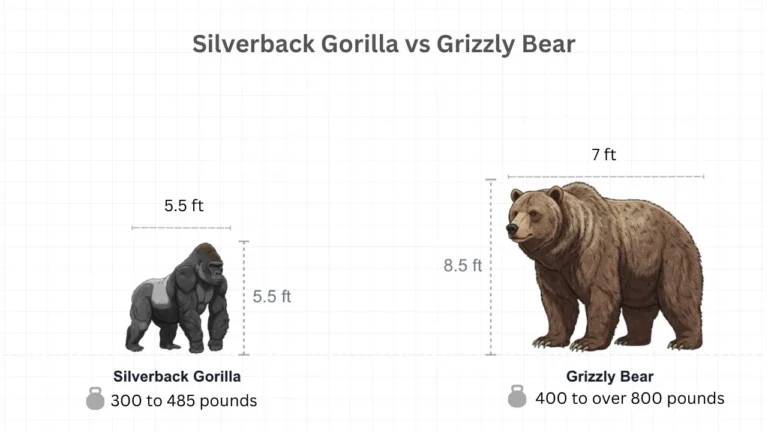
Read also Silverback Gorilla vs Grizzly Bear
Conservation Status
| Species | IUCN Status | Population Estimate | Primary Threat |
|---|---|---|---|
| Polar Bear | Vulnerable | 22,000-31,000 | Climate change |
| Kodiak Bear | Least Concern | ~3,500 | Habitat protection |
The size debate may be interesting, but ensuring both species survive is what truly matters.
Whether you’re Team Polar Bear or Team Kodiak, one thing is certain: encountering either of these magnificent giants in the wild would be the experience of a lifetime—preferably from a very safe distance!