Russia vs USA Size Comparison: Which Country Is Bigger?
When people compare countries by size, one of the most common questions is: Is Russia larger than the United States? The simple answer is yes. Russia is the largest country in the world and is significantly bigger than the United States in terms of total land area.
However, the comparison becomes more interesting when we look at land area, population density, geography, climate, and how much of each country is actually habitable.
In this article, we will compare Russia and the USA in detail and explain the real difference between these two giant nations.
Russia vs USA Size at a Glance
| Feature | Russia | United States |
|---|---|---|
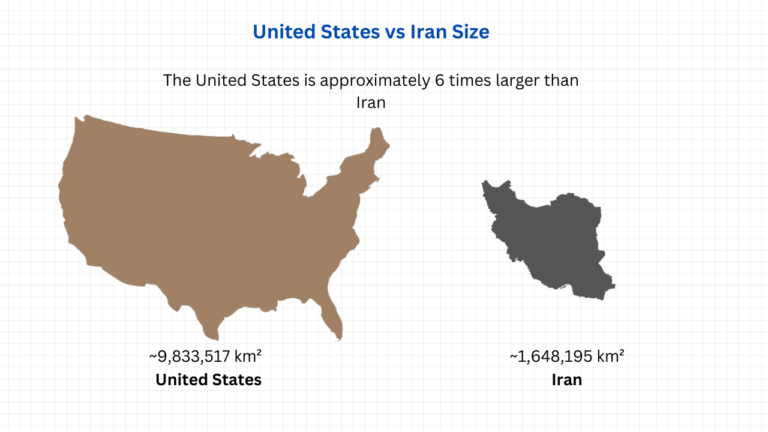
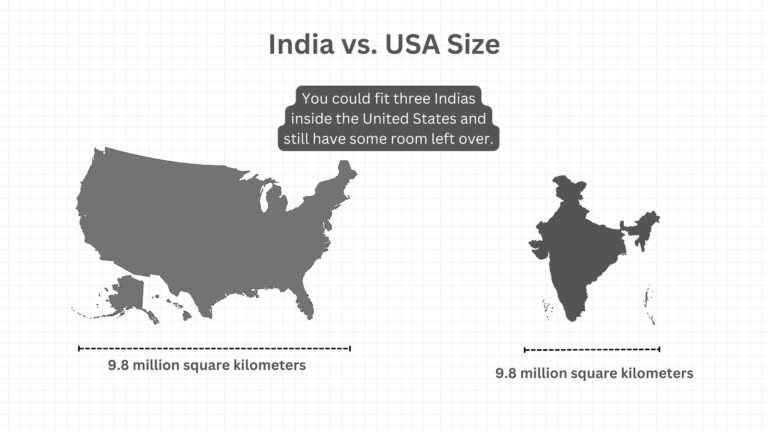
| Total Area | 17.1 million km² | 9.83 million km² |
| Land Area | 16.38 million km² | 9.15 million km² |
| World Ranking by Area | 1st | 3rd |
| Population | ~146 million | ~340 million |
| Number of Time Zones | 11 | 6 Main Time Zones |
| Longest Distance East to West | ~9,000 km | ~4,500 km |
| Continents | Europe & Asia | North America |
How Much Bigger Is Russia Than the USA?
Russia covers approximately 17.1 million square kilometers, while the United States covers around 9.83 million square kilometers.
Difference in Size
Formula
Russia Size − USA Size
Calculation
17.1 million km² − 9.83 million km²
= 7.27 million km²
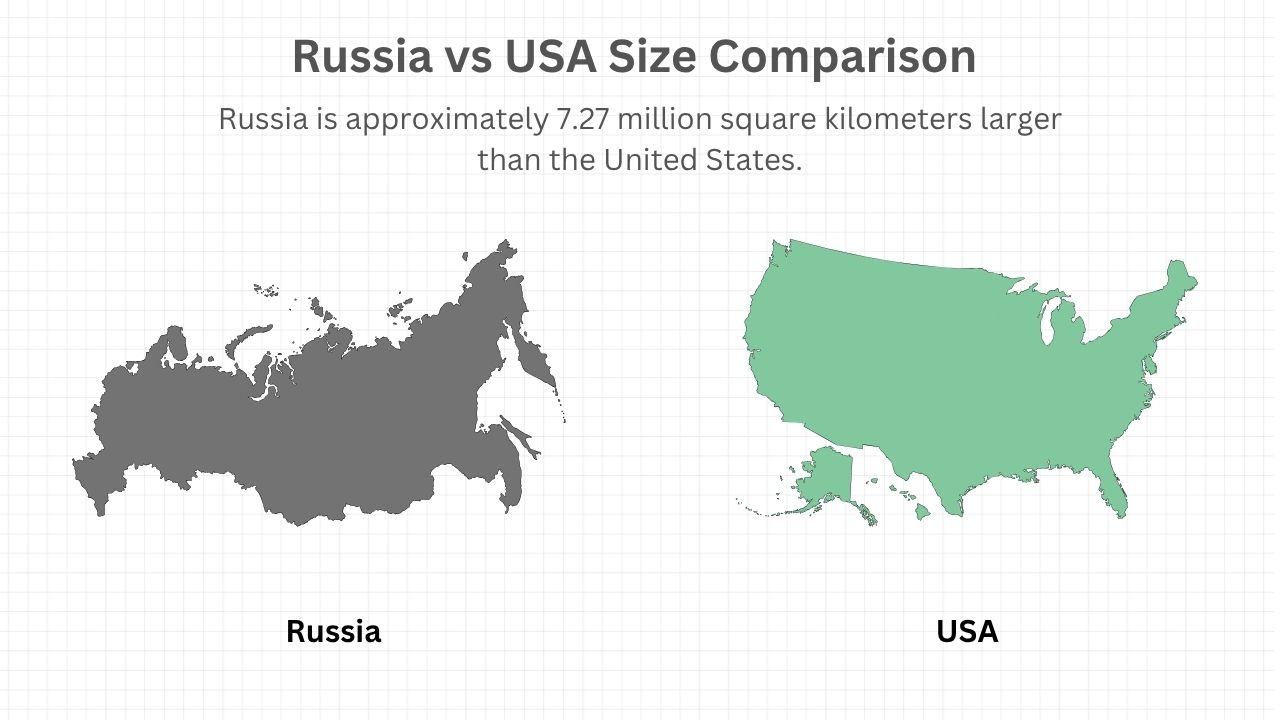
Russia is approximately 7.27 million square kilometers larger than the United States.
Percentage Difference
Russia is about:
This means Russia is roughly 74% larger than the USA.
Visual Comparison
If the continental United States were placed inside Russia, there would still be a huge amount of Russian territory remaining.
Russia stretches from Eastern Europe all the way to the Pacific Ocean. The country spans nearly one-eighth of the Earth’s inhabited land surface.
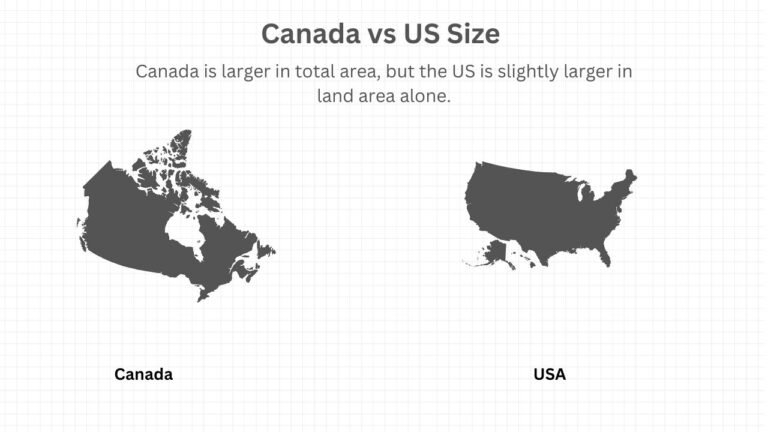
Many U.S. states could fit within Russia multiple times over. See the compare Canada vs USA.
Examples
| State | Area |
|---|---|
| Alaska | 1.72 million km² |
| Texas | 695,662 km² |
| California | 423,967 km² |
Russia is nearly:
- 10 times larger than Texas
- 40 times larger than California
- About 10 times the size of Alaska
Why Does Russia Look Even Bigger on Maps?
Many world maps use the Mercator Projection.
The Mercator projection enlarges areas closer to the poles. Since Russia is located far north, it appears even larger than it actually is.
Although Russia is truly the largest country in the world, some maps exaggerate its size visually.
Modern projections such as the Gall-Peters projection provide a more accurate representation of relative land areas.
Land Area Comparison
Water bodies affect total area measurements.
Russia
- Total Area: 17.1 million km²
- Land Area: 16.38 million km²
United States
- Total Area: 9.83 million km²
- Land Area: 9.15 million km²
Even when comparing only land area, Russia remains dramatically larger than the United States.
Population Comparison
Interestingly, the larger country has a much smaller population.
| Country | Population |
|---|---|
| Russia | ~146 Million |
| USA | ~340 Million |
The United States has more than twice the population of Russia despite being much smaller in area.
Population Density
Russia
USA
The USA is roughly four times more densely populated than Russia.
Climate and Geography
Russia
Russia experiences some of the harshest climates on Earth.
Major geographic features include:
- Siberian tundra
- Taiga forests
- Arctic coastline
- Ural Mountains
- Volga River Basin
Large portions of Russia are permanently frozen or experience extremely cold winters.
United States
The United States has a more diverse climate.
It includes:
- Deserts
- Tropical regions
- Temperate forests
- Mountain ranges
- Arctic areas in Alaska
This diversity makes much more of the U.S. suitable for agriculture and settlement.
Largest States and Regions
Largest U.S. State
Alaska
Area:
Largest Russian Federal Subject
Sakha Republic (Yakutia)
Area:
Yakutia alone is almost twice the size of Alaska.
Natural Resources
Both countries are rich in natural resources.
Russia
Major resources include:
- Natural gas
- Oil
- Coal
- Gold
- Diamonds
- Timber
Russia possesses some of the world’s largest energy reserves.
United States
Major resources include:
- Oil
- Natural gas
- Coal
- Copper
- Uranium
- Agricultural land
The USA is among the world’s leading producers of energy and food.
Economic Comparison
Despite being smaller in area, the United States has a much larger economy.
| Metric | Russia | USA |
|---|---|---|
| GDP (Approx.) | $2 Trillion | $30 Trillion |
| Population | 146 Million | 340 Million |
| Area | 17.1 Million km² | 9.83 Million km² |
Economic size does not necessarily correlate with land area.
Time Zones
Russia
Russia spans: 11 time zones
It is the country with the greatest number of time zones in the world.
United States
The U.S. spans: 6 primary time zones
Including Alaska and Hawaii.
Interesting Facts
Russia
- Largest country on Earth.
- Covers about 11% of the world’s land area.
- Borders 14 countries.
- Extends across Europe and Asia.
United States
- Third-largest country by area.
- Has the world’s largest economy.
- Contains 50 states.
- Alaska is larger than Texas, California, and Montana combined.
Russia vs USA: Key Differences
| Category | Winner |
|---|---|
| Total Area | Russia |
| Land Area | Russia |
| Population | USA |
| Economy | USA |
| Number of Time Zones | Russia |
| Population Density | USA |
| Agricultural Productivity | USA |
| Natural Resources | Both Strong |
Conclusion
Russia is substantially larger than the United States in terms of total area. With approximately 17.1 million square kilometers, Russia is about 74% larger than the USA and remains the largest country in the world.
However, size alone does not determine a country’s influence or development. The United States has a much larger population, a stronger economy, and more densely populated and productive land. Russia’s immense size is balanced by its harsh climate and vast sparsely populated regions.
In short:
- Russia is bigger geographically.
- The USA is larger economically and demographically.
- Both nations are among the most influential countries on Earth, but they achieve their global significance in very different ways.